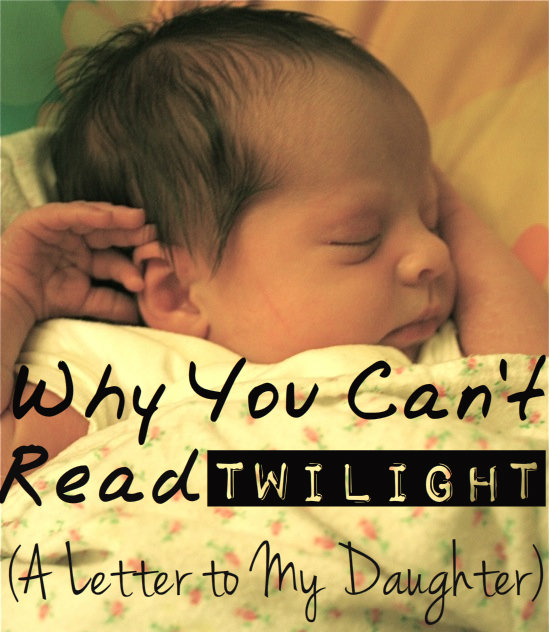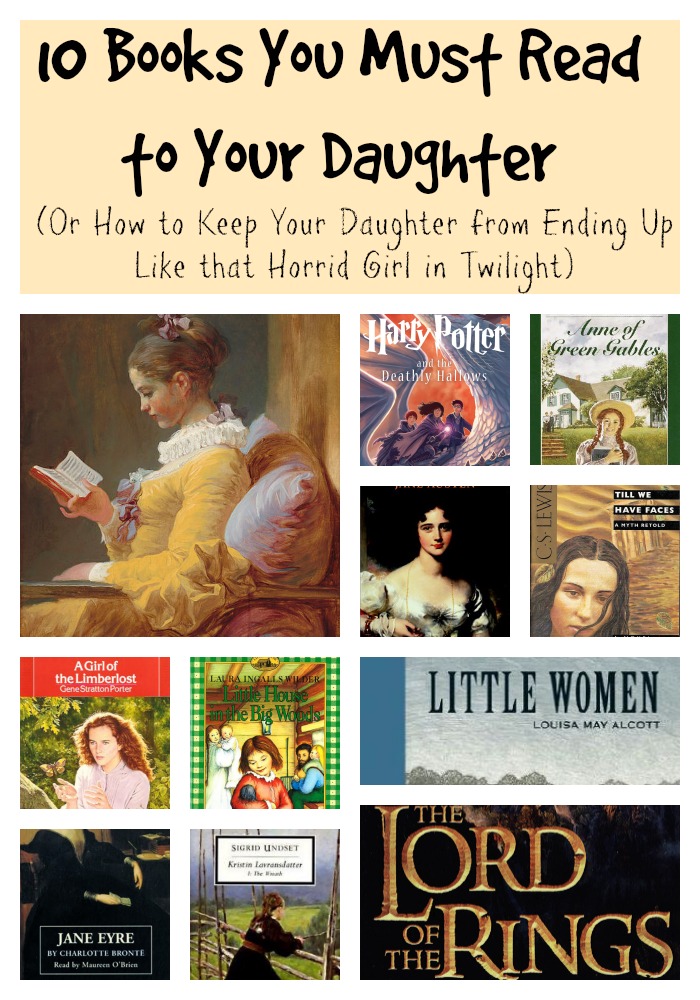
I am surprised by the popularity of a post I wrote a few weeks ago: “Why You Can’t Read Twilight: A Letter to My Daughter,” and I’m simply fascinated by some of comments it’s received. Some folks love it, but boy does it rub some people the wrong way!
Many commenters think the idea that I would tell my daughter at say, age 11, that she can’t read Twilight is downright loony and they refer to my daughter’s “right” to read it. Now, I aspire to fight for many rights for my daughter: the right to a loving family, the right to a happy home, the right to a good education, the right to nourishing food, etc. But I guess I just wasn’t familiar with the “right” to read bad novels.
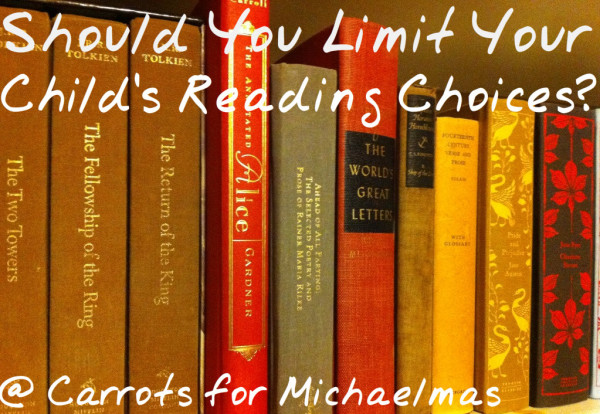
I believe Twilight is a waste of time and poorly written. And more importantly, it contains unhealthy views of women and relationships that I believe could be detrimental to a young mind’s developing ideas of self, love, and relationships. But I don’t think Twilight is really the issue. The real question is: Is it crazy to not let your child read certain books? Should we, as parents, limit our children’s reading choices?
Many critics of my decision to say “No” to Twilight just hated the idea that I was taking away a choice my daughter might want to make. If only I “trusted” her to make the right decisions, they lament, instead of limiting her choices! This line of thinking surprised me because limiting choices is simply part of being a parent. Few parents I know would allow their very young children to view R rated movies, for example. As parents, we strive to offer our children good choices that are appropriate for their age and maturity level. We do not offer them choices that we are fully aware are inappropriate or may cause them harm. We might allow our child to make the choice to ride a bike, but we would not allow her to make her own decision about whether or not she wanted to ride on a busy street without a helmet at night. We do not say, “You want to go to the mall instead of school today? Great! I respect your ability to make decisions!” Sorry. As parents, we limit choices. It’s just what we do.
Perhaps a better example is how parents deal with food choices. My 3-year-old son would eat candy for every meal if I recognized his “right” to eat whatever he desired. If I acquiesced to his constant requests for sweets, with the full knowledge that I was causing him physical harm, that he would likely develop diabetes, and that he was missing out on all the nourishing foods his body needs because he was filling up with sugar, I would not be a good mother. And it’s not because I don’t “trust” him. It’s because I know that he is three and that as a young child, the allure of sweets is stronger than his nutritional knowledge and his ability to make great choices regarding food. So, what do I do? When he asks for a treat I offer him good choices: peanut butter and apples, dried fruit, etc. Things that have nutritional value, won’t harm his body, and might partly satiate his desire for a sweet treat. Through offering him these choices rather than junkfood, I am teaching him healthy eating habits he can carry with him through life. So when the day comes when he is making all of those decisions himself, he will have a developed palate for good foods and the knowledge needed to nourish his body well. Does that mean that he won’t ever make bad choices? No. He might eat Cinnamon Toast Crunch for every meal. My concern is doing the task before me well: giving him the right tools he needs to be able to make good decisions about food.
Why isn’t it the same story with books? Do we not really believe that the books we read form us into the people we are? I want to offer beautiful and good literature for my daughter’s developing mind and soul rather than presenting her with the ultimate junkfood of books. In other words, I want to help her develop a taste for good literature. Because I’ve been an 11-year-old girl and—while I’d love to pretend that I had everything figured out as a pre-teen—let’s be honest: I was still forming crucial ideas, particularly about love and relationships. Would I have had the maturity to see through the ridiculousness of Meyer’s series at that age? Doubtful. It’s written to appeal to a fantasy of immature ideas of love. It’s MADE to be enticing to preteens. It’s even enticing to some grown women. Now, does this mean that as a teenager, my daughter won’t be allowed to read it if she really wants to? No. I hope that by that age she would have fallen so in love with good literature that reading Twilight would be an unattractive option to her. But she very well might read it some day. I’m not worried about that. My job is to offer her books that will nourish her developing mind, aren’t a waste of time, and that don’t present her with terrible relationship models during her formative years. If and when she gets her hands on Twilight, she will already be well-versed in truly good literature. And whether she likes Twilight or not, she will at least see its inadequacies.
Some of the other popular arguments for why I should let my children read Twilight are interesting, as well. One argument in their favor claims that the books are entertaining. But, to say that something is entertaining is not to say that it is good or that it is bad. It merely means that it holds your attention. Most parents have some sort of guidelines about what movies their children are allowed to view…and it doesn’t have anything to do with how entertaining the film may or may not be. Others said that reading Twilight is a positive thing because it’s better than just sitting in front of the TV, not reading ever, or reading books like 50 Shades of Grey. So, reading Twilight is better than frying your brain, being illiterate, or reading the most inappropriate book for children that you can think of? Wow! Impressive. Can’t we offer our kids better options than “well, it’s not the worst thing you could do with your time”? Why settle? Another recommendation is that the Twilight series is easy and gets kids reading. Seventeen magazine is easy reading, but nobody’s vouching for it’s literary value or that it spurs young readers on to great heights of literary achievement.
I have been advised by the Twilight fans that my daughter will hate me forever and eternally resent my decision to not let her read Meyer’s literary atrocity as a pre-teen. To be honest…I’m just not really worried about it.
My job as a parent is to do what is best for my children. It would be great if, one day, my daughter were able to fully understand and appreciate every decision I make concerning her. Sure, it would be sad if my daughter resents my decisions. But those decisions are based on well-thought-out reasons and I am not going to change them to satisfy the whims of a child.
Do you think it’s appropriate to limit your child’s reading choices? Join the conversation!
(This post is linked-up today at The Parent ‘Hood)