Tag Archives: homeschooling

Catholic Preschool Curriculum Review: Twenty-Six Letters to Heaven

Although we decided long ago that we would homeschool Benjamin during his preschool years, we’re still figuring out exactly what that will look like. Whenever his interest in a certain thing is peaked, we try to follow his lead and offer him resources to learn more. School for us this year is very flexible and I don’t think Benjamin has made a distinction between playtime and schooltime (and they are essentially one and the same right now.)

But Daniel and I have two goals in mind for him this year: mastering the alphabet and learning about our Catholic faith. Although Benjamin has been able to recognize the capital letters for ages, I want to work on lower case letters and learning to write out the letters this year. I also want to study the saints with him. And y’all, I found the perfect curriculum for us: it’s titled Twenty-Six Letters to Heaven by Sarah V. Park.

 If I had to classify it into a certain homeschooling methodology I think I’d align it with Charlotte Mason. It’s very literature-centered, simple, hands-on, and imaginative. For each letter of the alphabet, the author provides options for a saint of the week (Saint Anne for A, Saint Benedict for B, etc.) as well as a coloring page for each saint and a list of picture books about the saint’s life.  Also included is a Scripture verse to memorize about a particular virtue (Bravery for B), crafts and activities (such as making ants out of construction paper for A) that promote learning in art, math, or science, recipes (Ants on a Log for A) and, what I love most about this curriculum,  fantastic booklists of picture books featuring the letter of the week. I think of myself as pretty well-versed in children’s books but we have checked out so many wonderful twaddle-free books I have never seen before due to Park’s suggestions.

The other aspect I love about this curriculum is the flexibility. It can easily be fitted to your child’s needs, development, and level of interest. In fact, there’s one aspect of the curriculum that I’m just completely skipping. The author suggests making a collage each week of magazine pictures of objects starting with the featured letter. I hate keeping up with magazines and the idea of little pieces of magazine creeping throughout the house because of making these collages makes me feel a little crazy. But leaving that out doesn’t make the rest of the curriculum fall apart. I love it. And you don’t have to do certain activities on certain days or follow a particular schedule (something I wasn’t at all prepared to do this year). You can do everything in one day or spend two weeks on a letter. The art projects are easy and don’t require a trip to the craft store for supplies. It’s very simple and natural curriculum, but provides just enough structure and foundation that I don’t have to come up with all our homeschooling ideas myself. (I am so NOT SKILLED in the ways of crafty artsy projects.)

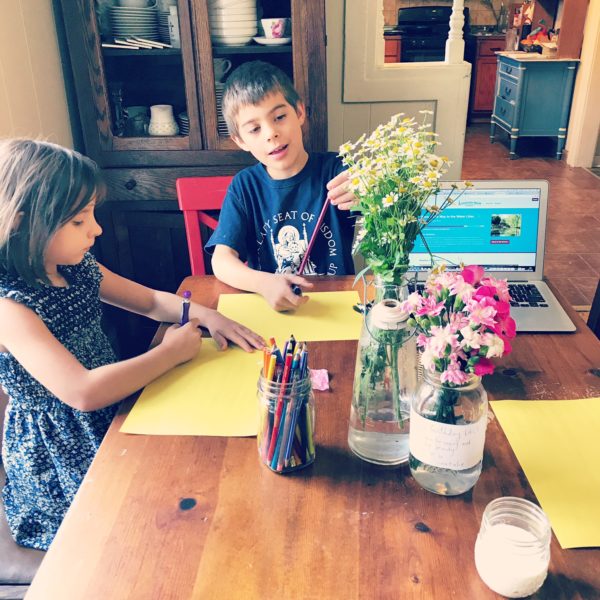
This week we’re studying the letter B. So far we’ve read all of our “B” picture books from the library and yesterday Benjamin wrote his own book and illustrated it. Making your own book out of construction paper is such a simple idea but I wouldn’t have thought it up myself without some effort (especially with my “pregnant brain.”) He dictated his book about trucks to me and had a blast illustrating it.

You can’t touch a truck’s engine because it might be hot.”

It also includes other vehicle safety tips from Benjamin like, “Don’t try to drive a car without your Mama and Daddy.”

Tomorrow we’re going on a field trip to a local living history museum so we’ll probably wait to talk about St. Benedict and explore some of the art, science, and math ideas next week. (Oh, the flexibility!)

I highly recommend Twenty-Six Letters to Heaven if you’re looking for a wonderful Catholic curriculum for your three-, four-, or five-year-old!

Disclosure: Hillside Education graciously sent me a review copy of Twenty-Six Letters to Heaven. I was not paid to review this curriculum. All of the above opinions are fully my own.

EmailFacebookGoogle ReaderPinterestTumblrTwitterShare

Preschooling at Home: Our Vision

I promised to follow-up our “why” we’re homeschooling post with a “how we plan to do it” post. And I thought I’d start out by addressing a great question from a reader who asked, “Why bother “pre school homeschool” anyways?…I might have a stricter idea of preschool homeschooling in my mind though, I really see formal preschool as something that could get in the way of natural play and development at that age.” I completely agree that “natural play” is what we should be going for. Children are natural learners and I aspire to encourage our preschooler’s natural desire to learn and grow through our “homeschooling.” Here’s how I feel about early homeschooling:

We’ve been “homeschooling” since Benjamin was born. We would read aloud to our fussy, colicky newborn during those loooooooooong sleepless nights: Peter Pan, The Iliad, and The Silmarillion. We read board books ad nauseum. We talked to our infant son, pointed out animals and plants, and explained what they were. And we’ve been answering those “What is that?” “Why does it do that?” “How does that work?” questions til we’re blue in the face. This is all part of our son’s education. The only reason we’re calling it “homeschooling” now is because he’s starting to be school age (3.5) and seems to be needing a little bit more structure to his days to prevent boredom. Basically, we want to offer him the resources to satisfy his seemingly insatiable desire to learn about the world around him.

We began by making some goals with Benjamin. We asked him: What do you want to learn about? We wanted to see where his interests currently lie. He told us that he wanted to learn about two things: “Space and Dinosaurs!” So, we ordered bunches of books from the library and are having a blast. (Our Space preschooling curriculum coming soon!)

Daniel and I also have some goals in mind for the year. We want him to do a little bit of pre-reading. He already knows all the uppercase ABCs and some of the lowercase but we want to spend more time getting familiar with the lowercase letters, reinforce what sounds each letter makes, and practice writing them. Benjamin is very interested in learning to read and will “read” aloud to himself books that he has memorized. So we want to offer him some resources to progress toward reading. However, if he doesn’t seem interested in the pre-reading activities we have in mind we will take a break and wait until he gains interest again.

We also will begin to do some learning together about our Catholic faith that follows the Christian Year. A friend gave me a great resource that is a curriculum for Home Catechesis for 3-6 year olds that looks perfect for Benjamin. It’s by Moira Farrell and is in the Montesorri tradition. I couldn’t find it on Amazon but you can find it here. Our first “lesson” will be setting up our family altar. We would also like to memorize more prayers with him. He has known the Our Father, Hail Mary, and Glory Be since before he turned two and he recently mastered the Bless Us, O Lord for mealtimes. But I think the Memorare, the Hail, Holy Queen, and the Prayer to St. Michael would be good ones to work on this year.

During read aloud time (which isn’t a set time at our house, just whenever Lucy is occupied or sleeping and I’m having one-on-one time with Benjamin) he asks to read our new library books about Space or ABCs. When he asks to be read something else, I obviously don’t say “no, we’re doing school now and that storybook isn’t on our syllabus!” I just try to use the library resources when the right moment strikes. If he doesn’t seem interested for a whole day (or a whole week), no big deal.

It’s also important to me to incorporate the visual arts and music into our learning (more on that when I explain our “lesson plans” for our unit on space.)

So, in our minds, “preschooling at home” is simply providing Benjamin with the resources to learn about what interests him, to spark his imagination, and to encourage him to develop skills that will help him learn to read when he’s ready. There will be a whole lot of the same activities we did last year: reading together, going to museums, going to the IMAX, playing outside, cooking inside, going to the park with friends, etc.

Do you have little ones learning at home? What is your vision for preschooling?

p.s. Thank you for your concern, love, and prayers for our little Benjamin! Your comments and emails are so appreciated. He is doing MUCH better. Breathing treatments are keeping his asthma under control and his terrible cough seems to be more from the little virus he’s been fighting off than because he’s struggling to breathe. His temperature is down and he’s back to his old tricks :) So glad to have my sneaky, wild, always hungry boy back after a couple days of no appetite and lethargy!

EmailFacebookGoogle ReaderPinterestTumblrTwitterShare

My Homeschooling Experience

After last week’s post on why we’re homeschooling, readers had some questions about what my homeschoolinge experience (3rd-8th grade) looked like. I thought I would answer in a short post tonight since tomorrow’s posting prospects are looking grim. Benjamin’s having trouble with his asthma and I have a premonition that tomorrow will involve a long morning at the Dr.’s office. (Please pray he improves tonight. His last attack landed him in the hospital and I’m just on pins and needles worried about my little guy.)

So, my experience homeschooling:

My parent’s approach was very literature-based. Basically, I just read all the time, mostly classics, some contemporary. My parents gave me some guidance, but I was a very self-motivated little gal and had the freedom to read whatever interested me (within reason I don’t remember wanting to read anything super trashy, but if I had I’m sure my folks would have redirected me.) This highly unstructured style worked in my situation because I was such a self-starter; however, we are planning a somewhat more structured curriculum for our kids.

In addition to daily reading, I would do creative writing projects and some essays in middle school. I also did math every day, studied Spanish on and off, and learned Greek and Latin root words. I would occasionally do science experiments and I created “unit studies” on whatever topic I was interested in: Laura Ingalls Wilder, the Romanovs, Greek Mythology, Arthurian legends, etc. I also participated in a middle school history fair, did historical re-enacting at a local historical site, and suffered through the county-wide public speaking contest. I was involved in tons of extra-curriculars: ballet, gymnastics, art, piano, voice.

That’s really it. I was usually finished with school work by 10am and spent lots of time riding bikes, playing with friends, and just being a kid.

When I went back to traditional school for high school I was generally bored and (except for two fantastic history classes) was not challenged academically.  I got straight As and was fully prepared when I entered college on full scholarship as a National Merit Scholar. So, the laid-back approach to homeschooling served me well as far as preparing me for high school and college and I got to skip going to middle school (which seems to be without exception, a misery of miseries.)

Were you homeschooled? What was your experience?

EmailFacebookGoogle ReaderPinterestTumblrTwitterShare

Why We Are Homeschooling (From a Gal Who Tried Everything)

At 5am on Sunday morning, my husband woke up our 3-year-old son, Benjamin, and took him on a surprise adventure. They drove away from the light pollution of the city and found a place they could watch the Perseid meteor shower. After laying out a blanket and showing him where to look, my husband got to witness the delight on our son’s face when he saw a shooting star for the first time. When they got home Benjamin was beaming and couldn’t wait to tell me all about it. He explained that “shooting stars are called ‘meteors’ not ‘meat-eaters’ like dinosaurs and I saw TWO. They went like this ‘WHOOOOSH!” He went on to tell me that he saw two planets, Jupiter and “Eunice.” “Venus?” I asked. “Oh, yeah, Venus! That’s right! And we saw a constellation: Orion! He has a belt made of three stars!

Benjamin called it “an adventure.” It was also homeschooling.

It’s the start of a new school year and since I posted this great article and mentioned on FB that we’re starting some unofficial preschool homeschooling for our 3-year-old son, Benjamin, I had some requests for a more in-depth explanation of my experience as a homeschooler and our vision for homeschooling our kids. I thought I’d start with the “why” and do some later posts on exactly what homeschooling will look like at our house.

I never attended a Montesorri or Parochial school but I tried everything else under the sun: private Christian school (Pre-K-2nd), homeschool (3rd-8th), private secular school (10th) and public school (9th, 11th, and 12th). I didn’t hate conventional school. I was a straight A student.  So why are we homeschooling?  Well, we can’t think of any good reason to send our kids to school! If you’re interested in reading about modern education and its many problems, please read Anthony Esolen’s amazing book: Ten Ways to Destroy the Imagination of Your Child. It is truly life-changing and expresses so much of what we believe about education.

As for the benefits of homeschooling, here are some of our reasons for embracing it for our children’s education:

1. We don’t think learning begins and ends in a classroom and we don’t want our kids to believe that either.

2. We believe that every child is unique and will learn best with an education tailored to their learning style, strengths, and weaknesses.

3. We want our children to be challenged, engaged, and enchanted by learning. In essence, we want our kids to love learning instead of becoming skilled at the “grade game.” (Daniel and I both were great at knowing what we needed to know for the test. We do great on tests. From experience, we know that’s not the same thing as learning.)

4. Because there’s no way our son could sit still in a classroom environment. If you’ve ever sat behind us at Mass, you will understand this. We want him to run wild and just be a little boy in addition to learning his ABCs, how to count, etc (which he already does).

5. We want learning to be naturally woven through our days. We don’t want a 7hr block of time devoted to “school” that feels like “work” to our children.

6. We want to teach our children things they won’t learn in traditional school: classical and biblical languages (Latin, Greek, and Hebrew), music, art history, the lives of the saints, etc. (You might be able to take some of those in high school but they weren’t available at our high schools).

7.  We enjoy our kids and want our family to be together as much as possible.

8. We want to be the primary influence on our children’s lives. I have lots of friends who are teachers. They are awesome. I have also had lots of teachers in my many years of different kinds of schooling: they were NOT all awesome.

9. We want the freedom to celebrate the liturgical year. The calendar we go by isn’t the traditional school calendar. We will be celebrating the Feast of the Assumption tomorrow. And nobody has to skip school to do it!

10. We’re not even remotely worried about “the socialization issue.”  The idea that our kids won’t be just like everybody else’s kids is not a negative for us.

11. We don’t want our kids to be bored because they are pigeon-holed into a certain “level.”

12. We want the freedom to stay home, go to the library, visit a museum, etc. Whenever we want to.

13. We want our kids to have time to study musical instruments and participate in extracurriculars like dance, art, and sports without being stressed-out, overwhelmed, and exhausted (as a ballet teacher I see far too many pale faces and tired eyes after a long school day and it breaks my heart).

14. We don’t want our children’s imaginations ruined by the school system. As a voracious reader my whole life, nothing could destroy my love for literature. But my high school English teachers sure gave me a run for my money! Really, if anyone could have killed my passion for books it was those four women. In fact, in all of high school, I can only think of two really excellent teachers that I would want teaching my kids.

15. I’m not prepared to send my kids off to have so much time wasted every day. Because I spent so many years in traditional classrooms I know how much time is wasted. Between the discipline issues, teaching to standardized tests, and just watching movies in class, so many of my days were wasted. I’m not going to let that happen to my kids.

16. No one cares about our children’s education as much as we do.

EmailFacebookGoogle ReaderPinterestTumblrTwitterShare