Category Archives: Prayers

The Feast of St. Andrew, Nov. 30th

Tomorrow is the Feast of St. Andrew. Daniel whipped up this fabulous meal of Tahini Tilapia for our celebration of St. Andrew (a fisherman)  a couple of years ago and it’s still a staple at our house. And since November 30th is on a Friday this year, how handy that it’s fish for us Catholics, right?

The following is drawn from a post on Feast!, our woefully neglected Christian Year blog, that my husband Daniel posted in 2010. I’m more than a little embarrassed at how bad our photography was back then but…here ’tis:

Fisherman, brother of Simon Peter, friend and apostle of Christ, evangelist, and martyr. Andrew was first a disciple of John the Baptist and, according to John the Evangelist, was the first disciple called by Christ. After Christ’s death, resurrection, and ascension, St. Andrew went out to preach the Gospel. He travelled as far north as the Black Sea (which is why he is patron saint of Russia and the Ukraine) but was finally martyred in Achaea, Greece.  Ancient sources say Andrew was bound, not nailed, to a cross.  Iconography from the middle ages shows his cross to be raised in the shape of an X, hence the familiar “St. Andrew’s Cross” on the Scottish flag.

For today’s feast we made fish in remembrance of St. Andrew’s first profession. I don’t know exactly what kind of fish Andrew would have caught. But I read that tilapia are still caught in the Sea of Galilee and they’re an easy fish to find at the grocery store so we went with that. Then I found this Middle Eastern recipe for fish with tahini sauce and adjusted the proportions. Here are the ingredients for the sauce:

We also had couscous and sautéed greens from our garden. Spinach, kohlrabi, Swiss chard, and parsley.

Here’s the final product.

O glorious St. Andrew, you were the first to recognize and follow the Lamb of God. With your friend, St. John, you remained with Jesus for that first day, for your entire life, and now throughout eternity. As you led your brother, St. Peter, to Christ and many others after him, draw us also to Him. Teach us to lead others to Christ solely out of love for Him and dedication in His service. Help us to learn the lesson of the Cross and to carry our daily crosses without complaint so that they may carry us to Jesus. Amen.

Has your family ever celebrated St. Andrew’s Day? 
EmailFacebookGoogle ReaderPinterestTumblrTwitterShare

Keeping Vigil

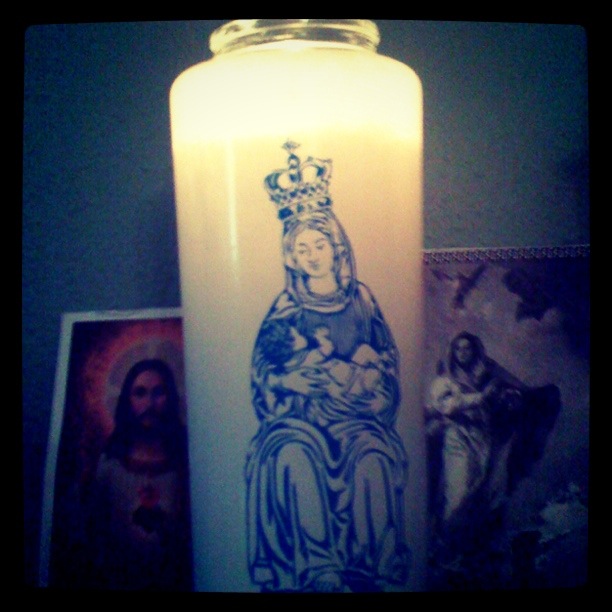
On Friday morning when I woke up, I lit a candle we brought back from St. Augustine for a friend who was in labor. I knelt and prayed for mother and baby in front of our family altar, asking for a safe and joyful delivery. By noon, I heard that mama and baby were safe and after saying a prayer of thanksgiving for the miracle of new life, I blew out the candle and went about my day.

That afternoon, I received news that sent my head was spinning and I sat down on the hardwood floor when I heard that a very beloved professor who became a dear friend was dying. I hadn’t even known she was ill. A mutual friend got in touch with me to say that after a valiant fight against leukemia, she was going home to spend her last days with her family. She has twin girls, only nine years old. Her name is Susan and she is lovely. Although I didn’t even take one of her classes, she took the time to befriend me. Not because it would help her career, she taught in a different department, just because she knew I was overwhelmed and lonely as a new mother and needed a friend who wasn’t a single college student to talk to about motherhood. She and her husband would bring us meals and I would carefully watch her interactions with her twins, taking mental notes. She is such a good mother and after babysitting her daughters and spending time with them, it was clear that she and her husband had been so intentional and thoughtful in their parenting. Her girls are bright, warm, imaginative little girls with delightfully untidy curly hair. My heart breaks for them. Susan is the kind of mother that I strive to be. I still can’t believe that they will lose her. Losing a mother at any age is painful, but you so deeply need your mother at nine.

So, I lit a candle for the second time, knowing that this second vigil will end very differently than the first. I cried, prayed, and after nursing my baby to sleep, tried to go to bed myself.  When my teething baby girl woke every hour or so in the night to be comforted about her painful gums, I didn’t sigh at the frequent interruptions to my sleep like I usually would. I cherished every second of holding my precious baby close to nurse her back to sleep and prayed for Susan and for the girls she has to leave.

Birth. And Death. So close together. The similarity of birth and death was on my mind. This morning I heard that one of the twins will be baptized today. A beautiful depiction of death preceding new life. And I started to think that perhaps the first vigil is not so very different from the second. The pain and suffering of labor preceding the joy of new life. The pain and suffering of death preceding life eternal. The symbolism of baptism: dying to live in Christ. And I kept thinking about T.S. Eliot’s “The Journey of the Magi” :

were we lead all that way for


Birth or Death? There was a Birth, certainly,

We had evidence and no doubt. I have seen birth and death,


But had thought they were different; this Birth was


Hard and bitter agony for us, like Death, our death.

I thought about the birth of Our Lord, always under the shadow of the Cross. And I thought about the Cross: the defeat of death and our redemption, salvation, and only hope. Both new life, and both death. Joy and sorrow. Sorrow and joy.

As I keep vigil in my heart for Susan and her family, I will pray that the Mother of Our Lord will gather the girls under her starry mantle as they face the sorrow of losing their mother. And I will thank God for the honor of knowing Susan and for the hope for eternal life in the midst of pain.

The last enemy to be destroyed is death – 1 Corinthians 15:26

Please remember Susan and her family in your prayers.

EmailFacebookGoogle ReaderPinterestTumblrTwitterShare

I Hate Asthma

Just a quick note to ask for prayers for our sweet 3-year-old Benjamin Bear. He started having trouble with his asthma last night and after two breathing treatments, I took him to the pediatrician this morning who promptly had him transferred to the hospital. He’s wheezing, coughing, and having very labored, fast, and shallow breathing. The Dr. at the hospital is getting him set up with an IV of steroids as well as getting him some more oxygen. Benjamin is being sweet and compliant and still a little impressed with the novelty of his “special bracelet” and “a sleepover at the hospital with daddy.” But, I think our little spitfire is already starting to get bored. Please pray that he can recover quickly and go home tomorrow instead of in the  2+ days that the Dr. expected! I’ve never had one of my babies in the hospital for anything other than their birth so the whole thing is new, scary, and dreadful! Thank you for your prayers, you wonderful folks.

EmailFacebookGoogle ReaderPinterestTumblrTwitterShare

The Big Ol’ Catholic Reading List

Ok, so it’s not that big and it’s definitely not in the ballpark of comprehensive (would that even be possible?). But, in response to a reader’s request for resources on Catholic teaching, Catholic motherhood, Catholic blogs, and books that influenced our decision to convert, here’s…well, something. It’s off the top of my head with a couple suggestions and notes from Daniel. I would LOVE your suggestions and recommendations for additions!

CATHOLIC TEACHING/CATHOLIC THOUGHT:

(Daniel’s note regarding recommended reading for Catholic thought that also influenced our conversion:

“Read the Church Fathers, beginning with Ignatius of Antioch. Before I was Catholic, I thought that the Protestant Reformation was necessary because of a steady decline that had taken place in the Church from its very beginning. I thought that everything would be great if we could just get back to the Early Church. But I figured we just didn’t have a record of that time. Turns out, we do. Ignatius of Antioch lived in the first century and was martyred in the beginning of the second so his writing held a lot of weight with me. When I read his letters, I was quite surprised by what I found. Over and over again, he emphasizes loyalty to the bishops; an idea that was totally foreign to me. He spoke of the Church as a single organization with a hierarchy and chain of command. He also spoke of the Eucharist with great reverence and called it the ‘medicine of immortality.’

Continuing through the centuries… St. Augustine, St. Maximus the Confessor, St. Anselm. With these guys, it wasn’t so much a particular argument they made that drew me to the church. Instead, it was the continuity that exists over the centuries in their writings. This flew in the face of my idea that there was a ‘falling away’ from the truth. Quite the opposite, their was unbroken consistency of thought and teaching that existed from the early church all the way up to the contemporary Catholic Church. Maximus emphasizes this continuity (albeit in the 7th century).”)

A good place to start is with The Epistles of St. Clement of Rome and St. Ignatius of Antioch. There’s a good Paulist Press edition. Also worth reading are: The Prayers and Meditations of St. Anselm, Confessions or the Enchiridion of Faith, Hope, and Love of St. Augustine, and Selected Writings of Maximus Confessor.

The Catechism of the Catholic Church—doesn’t get much better than this. Confession: I haven’t read the whole thing. Maybe remedying that should (obviously?) be one of my Lenten devotions.

Signs of Life by Scott Hahn—Daniel and I read this together during Lent two years ago. There are 40 chapters so it’s perfect for lenten reading.  Dr. Hahn is also a convert and this book is a beautiful introduction to Catholic sacraments, sacramentals, and practices. Hahn includes many, many Scripture references in his chapters which is always helpful to those of us coming from a Protestant background.

Orthodoxy by G.K. Chesterton—Just awesome. Everything Chesterton writes is delightfully funny and painfully true.

On Being Catholic by Thomas Howard: Written by a convert, this book explains facets of the Catholic faith and Catholic worldview and dispells minunderstandings of the Catholic faith that might arise coming from a Protestant worldview.

On Loving God by St. Bernard of Clairvaux—Following in the footsteps of St. Augustine, this medieval saint writes beautifully. I am a medievalist at heart and I just love St. Bernard. Here’s an example: “Faith certainly bids me love him all the more whom I regard as that much greater than I, for he not only gives me myself, he also gives me himself.”

Why Do Catholics Eat Fish on Friday?: The Catholic Origin to Just About Everything by Michael P. Foley—Written by one of our Baylor profs, this is a delightful read.

And if you’re up for something dense but amazing—any of the writings of St. Thomas Aquinas.

CONVERSIONS:

Return to Rome by Francis Beckwith—Dr. Beckwith’s story of his reversion to Catholicism after becoming Protestant and being President of the Evangelical Theological Society.

Crossing the Tiber by Stephen RayPart I is his conversion story from Protestantism and Parts II and III are on Baptism and the Holy Eucharist.

Confessions by St. Augustine—the ultimate conversion story.

The Seven Storey Mountain by Thomas Merton—Another good conversion story highlighting the working of God’s grace guiding us, even when we are unaware.

Apologia Pro Vita Sua by the Blessed John Henry Newman—The spiritual autobiography of a former Anglican. Confession: I haven’t read this one, but Daniel really liked it.

CATHOLIC PRAYER AND DEVOTION:

St. Benedict’s Prayer Book—We love using this for morning and evening prayer for our family.

An Introduction to the Devout Life by St. Francis de Sales—Exhortations to holiness through prayer and examination of conscience by a wonderful saint of the Church.

The Rosary: Keeping Company with Jesus and Mary by Karen Edmisten—Fantastic introduction to praying the Rosary. I’ve read it twice and it has helped me make the Rosary a frequent and familiar devotion in my spiritual life.

MOTHERHOOD:

Familiaris Consortio, Encyclical by the Blessed Pope John Paul II: This one definitely falls into the category of Catholic teaching but has much to say on motherhood and the family in modern life. I’m more than halfway through and loving it.

HAGIOGRAPHY:

Catherine of Siena by Sigrid Undset—Well-researched and beautifully written biography of St. Catherine of Siena by Sigrid Undset, another fellow convert to Catholicism.

Saint Thomas Aquinas, “The Dumb Ox” by G.K. Chesterton—Nobody writes biography as delightfully as Chesterton. A wonderful introduction to this great saint.

FICTION:

ANYTHING written by Flannery O’Connor. My favorite is The Violent Bear It Away.

(Daniel’s note: “This is hard to explain. Perhaps it was that she was a Southern author writing about the South. I guess she was able to translate her Catholicism into the language of my Southern Protestantism. I can’t really put my finger on it. Obviously, the sacraments are a huge part of her work, even when they are slightly hidden. There is a kind of radicalism in her stories that makes sense to me and I think is a core part of the Gospel message. There is a totality to it that I think is clearly shown in Catholic theology. She also helped me see that some of my objections to the Catholic Church were actually rooted in my modern, materialist perspective and not really in anything biblical.”) Warning: If you’ve never lived in the South…these works might be really hard to understand.

Brideshead Revisited by Evelyn Waugh: THE 20th Century Catholic Novel. Wickedly funny and full of heartbreaking truth, Brideshead follows the working of God’s grace in the aristocratic Flyte family through the eyes of their friend Charles Ryder. I read it every year and the characters have become beloved companions. I can’t explain why, but I think this book influenced me to become Catholic more than any other.

Kristin Lavransdatter by Sigrid Undset: I’ve written about how much I love this saga before—how often do you find good medieval historical fiction? Kristin’s spiritual journey chronicled throughout the books is complex, beautiful, and worth reading.

The Lord of the Rings by J.R.R. Tolkien (Daniel’s note: “I guess this is hard to explain, too. Maybe part of it was that I absolutely loved Tolkien and his worldview. So the fact that he was Catholic made me see Catholicism in a more positive light. There are also a lot of sacraments in his work. The Eucharist shows up all the time.”)

What are your suggestions for MUST-READ books and resources on Catholic faith?

(p.s. Don’t forget to enter my giveaway for a copy of the clothbound Penguin classic edition of Pride and Prejudice! It ends tomorrow at noon!)

This post contains Amazon affiliate links. Thank you for supporting me!

EmailFacebookGoogle ReaderPinterestTumblrTwitterShare

October: The Rosary

Each month of the year has a special emphasis in the Church Calendar and October is dedicated to the Rosary.  Growing up Protestant, I was taught to be concerned by ‘rote’ prayers which lead to spiritual dryness and to instead use my own words in order to be more ‘authentic’ and ‘genuine.’ Yet, as I have been exposed to ancient prayers, I have found them not rote, but rhythmic, and not dry, but life-giving. I find great freedom in praying the words of the saints prayed by the faithful for centuries instead of making up my own words spontaneously. This is partly due to my lack of creativity when praying. If I depend on my own words, they usually are exactly the same as the last time, but they aren’t as rich or beautiful as more ancient prayers like the Rosary.

While praying each decade of the Rosary (a decade is an Our Father, ten Hail Marys, and a Glory Be) you are to meditate on one of the Holy Mysteries, such as the Annunciation or the Visitation. Familiarity with the prayers allows you to move beyond the words you are praying to scenes in the life of Christ and of his Mother, Mary. It becomes like a stained-glass window illuminating a scene from the Gospel as you view it. The more I pray the Rosary, the more layers I see unfolding. It is a rich prayer that never grows dull.

An excellent introduction to the Rosary is by Karen Edmisten, also a Catholic convert, called The Rosary: Keeping Company with Jesus and Mary.  It discusses theological and devotional aspects as well as practical methods of incorporating the Rosary into busy modern life.

Being unfamiliar with the Hail Mary until a couple of years ago, I was unaware that the first three lines are actually Scripture (the Gospel of Luke). The last two lines are a request for prayer. One of the most beautiful aspects of the Hail Mary is that the name of Our Lord Jesus is at the very center of the prayer:

“Hail Mary, full of grace, the Lord is with thee;

blessed art thou among women, and blessed is the fruit of they womb, Jesus.

Holy Mary, Mother of God, pray for us sinners, now and at the hour of our death.”

Pope Benedict XVI has said of the Rosary:

Together we confirm that the Holy Rosary is not a pious practice banished to the past, like prayers of other times thought of with nostalgia. Instead, the Rosary is experiencing a new Springtime. Without a doubt, this is one of the most eloquent signs of love that the young generation nourish for Jesus and his Mother, Mary. In the current world, so dispersive, this prayer helps to put Christ at the centre, as the Virgin did, who meditated within all that was said about her Son, and also what he did and said. When reciting the Rosary, the important and meaningful moments of salvation history are relived. The various steps of Christ’s mission are traced. With Mary the heart is oriented toward the mystery of Jesus. Christ is put at the centre of our life, of our time, of our city, through the contemplation and meditation of his holy mysteries of joy, light, sorrow and glory. May Mary help us to welcome within ourselves the grace emanating from these mysteries, so that through us we can “water” society, beginning with our daily relationships, and purifying them from so many negative forces, thus opening them to the newness of God. The Rosary, when it is prayed in an authentic way, not mechanical and superficial but profoundly, it brings, in fact, peace and reconciliation. It contains within itself the healing power of the Most Holy Name of Jesus, invoked with faith and love at the centre of each “Hail Mary”.

I’m trying to make the Rosary part of our daily routine, particularly during this month of October, but am more often than not failing to make it happen. Whenever we do incorporate it into our day (usually evening when Daddy is home) it is centering and a rich blessing.

Benjamin calls it a “reereeree.” I’d like to start praying a decade with him everyday. Right now we pray one Our Father, one Hail Mary, and one Glory Be just before bed but I think he might be ready to lengthen that prayer time little by little.

EmailFacebookGoogle ReaderPinterestTumblrTwitterShare