Tag Archives: wendell berry

6 Must-Have Books and Cookbooks for Seasonal Eating Inspiration

Since our conversion, I’ve gained more appreciation for the rhythms of the Christian Year and that by observing those seasons, the story of the Gospel unfolds. One way to participate in the Christian Year is to feast and fast according to the traditions of the Church which, obviously, involves food! Sharing food with family and friends should ideally be a daily reminder of sacred things: The Last Supper, the Holy Eucharist, and the Wedding Feast of the Lamb (all connected, of course). If we consider the partaking of food not as a mundane event but as an intersection with the sacred, then what we eat, where it came from, and who grew it becomes more important.

Something we try to add to the rhythm of our lives is the practice of eating seasonal food. It seems elementary to eat according to what’s growing but until recently I never knew what was in season–produce is available at the grocery store all year round! Until we started growing a garden, I really had no idea if it was the season for tomatoes or for butternut squash.

A few books have been really helped me understand some of these ideas.

I love this collection of Wendell Berry’s agrarian essays: The Art of the Commonplace. I’ve written about how Berry’s emphasis on the value of home has helped me embrace my vocation as a mother, but his essays have been just as life-changing in regards to food ethics. Please read ASAP!

Barbara Kingsolver’s farm memoir Animal, Vegetable, Miracle is a wonderful introduction to eating local and seasonal foods. It chronicles her family’s experience moving back to a family farm and producing almost all of their food for a year. I don’t agree with every little thing she says, but it’s a delightful read that found informative and inspirational.

Seasonally-organized cookbooks have also been really helpful in training me about what’s in season and how to cook according to what’s growing in our garden.

If you’re just starting out, I highly recommend Simply in Season (by the creators of More with Less, an essential on my mother’s cookbook shelf). It is organized by Spring, Summer, Fall, and Winter recipes and is very real food friendly. For someone like me who didn’t have the first idea how to cook an eggplant or a spaghetti squash when they showed up in our CSA bag or our frontyard garden, there’s a handy and simple guide in the introduction explaining how to prepare different kinds of produce in a myriad of ways. It is definitely my first stop when I’m trying to figure out how to prepare a veggie I’ve never cooked with or when I want to attempt a seasonal meal. The recipes sometimes need additional spice added but then again, we like things spicy!

And I also adore Brother Victor-Antoine d’Avila Latourrette’s cookbooks. They contain simple, frugal, almost entirely vegetarian natural food recipes by a monk who cooks with ingredients from his monastery garden. I love that they’re organized according to season and the Christian Year! Although, because Brother Victor-Antoine’s monastery is in the northeast, we have to make some substitutions because what’s in season in sunny Florida is usually a little different.

Twelve Months of Monastery Soups is a great and easy way to incorporate all those seasonal veggies. This one was gifted to us and we use it often. “The Monk,” as we affectionately refer to him, also has a Twelve Months of Monastery Salads, but we haven’t added it to our Cookbook Library yet.

We also love Sacred Feasts which is organized by month according to the feasts and fasts of the Christian Year. January, for example, contains seasonal recipes as well as specific ideas for Epiphany and Saint Anthony’s Day.

We recently acquired From a Monastery Kitchen which is similar to Sacred Feasts, but organized according to the four seasons instead of by month. We’ve never tried a recipe by Brother Victor-Antoine that didn’t turn out delicious!

Do you try to cook seasonally? What books have inspired and assisted you?


EmailFacebookGoogle ReaderPinterestTumblrTwitterShare

This Week’s Miscellany: Vol. 38

Happy Friday!

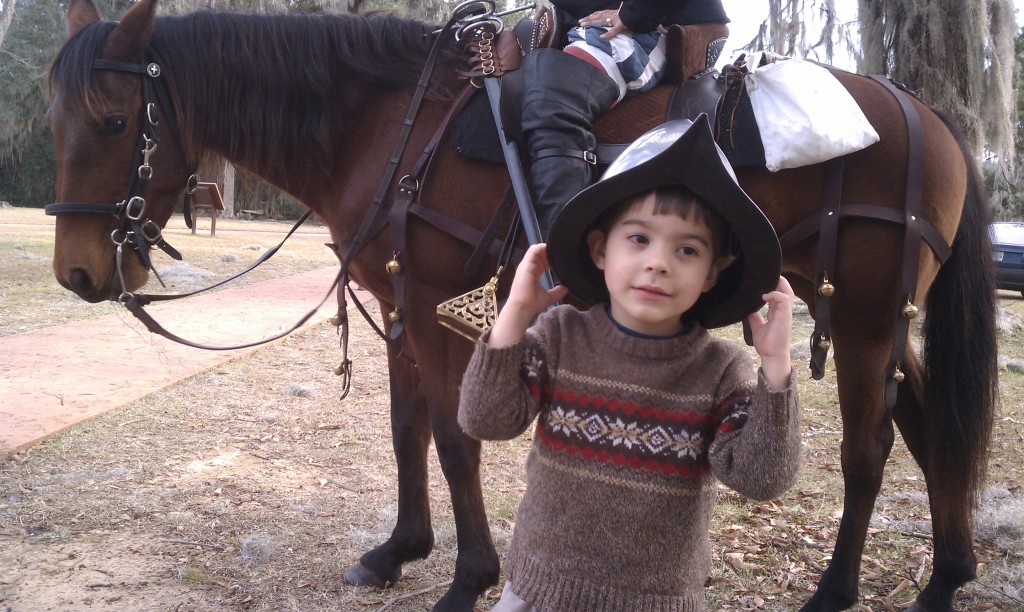
In the Liturgical Year: We finished our celebration of the 12 Days of Christmas with a bang at a local historical mission site where they had a “First Christmas in the New World” event.

IMAG0517

They had Las Posadas and our bishop said Mass there (but we missed out on those because of baby naptime). The kids loved the rest of it, though! We haven’t taken down our Christmas decorations and I’m loathe to. I love the light of the Christmas tree early in the morning. Can’t we keep it up til Candlemas, Daniel? Pretty, please? To be honest, we haven’t done much for Epiphany. We’ve settled back into our flexible routine: teaching ballet, preschool homeschooling, slow cooker meals, trips to the museum. I need to go ahead and get organized for Lent so it doesn’t sneak up on me. It’s so early this year!

Pregnancy Update: 21 weeks! I’ve been feeling much better as far as the pregnancy nausea goes. What a relief. When I feel so dreadful, it’s honestly hard for me to do much bonding with my baby in utero. But finding out the gender last week and choosing a name have really helped me start connecting with this precious little gal I’m carrying. And all her kicking and jumping around my womb certainly helps! She’s a little firecracker.

IMAG0546

In the Garden: Daniel really outdid himself this year with our garden. We have had so many delicious greens to eat. Swiss chard several times a week and enough lettuce (of many varieties!) to make beautiful salads every night. And now that the idea of vegetables doesn’t make me nauseous I can really enjoy the bounty!

Quote:

There are no unsacred places;
there are only sacred places
and desecrated places.
-Wendell Berry

The Quotable Benjamin:

Let me in, mama! I know you’re going potty but I have to go THE BADDEST!!!” (Oh, the joys of a one-bathroom household.)

It’s OK, Lucy. We love you no matter what!” (Lucy was going bare-bottomed to help with a diaper rash and had a few accidents. Benjamin was very understanding.)

Can we listen to “Sleigh Ride”? NOT the bossy version!
(By bossy version, he meant the Zoey Deschanel/M. Ward one. Love him.)

Links:

Wendell Berry’s Wild Spirit: Garden and Gun (I pretty much love anything Wendell Berry.)

Everything I Need to Know About Hospitality, I Learned from Molly Weasley: RNS (How could I resist sharing this? You know my love for Molly and the Harry Potter books. Also, be sure to read the first comment on the article. I laughed out loud.)

Are There Rules for Religious Art?: Simcha Fisher (One of my greatest passions is Christian art. If I were going back to school for something, it would be medieval Christian art. I think Simcha’s piece is great and starts a wonderful conversation.)

Bless This House: Surviving Our Blessings (I really want our priest to come over and bless our home. Why do I always forget about this?)

The Nap Window: Honest Toddler (This blog is so funny.)

Helpful Tips for Traveling with Cloth: Two Ortizes plus More (I’ve never really attempted this. Sarah does a great job of explaining how to make it work.)

Instagrams Worth Sharing (if you want to follow me, I’m carrotsformichaelmas on IG):

photo-438

My, she’s cute. And see? I really wasn’t lying yesterday when I told you my bath tub is moldy. (In my defense, our old-timey bathroom doesn’t have a vent installed so the mold gets out of control before you can blink an eye in muggy Florida. But, yes, also because I’m not good at this whole housekeeping thing.) Also of note: she was making this cute face because Benjamin was teaching her to say “poop.” Just trying to stay honest.

photo-439

“I found brother’s hat and am feeling very sneaky.”

More Miscellany:

I am starting to get the hang of Twitter, @haleycarrots, (barely, it still doesn’t feel as natural as FB) but I’m really enjoying connecting with readers there so follow me and I’ll follow back :)

And I realized this week that the button that should link to my Pinterest account (haleyofcarrots) wasn’t working. It’s fixed now so you can find me there, as well!

And while we’re talking social media, if you follow me on FB, you’re probably not seeing most of my posts in your news feed because of some changes FB has made.  If you want to see more of my updates, hover the mouse over the “liked” button at the top of the Carrots FB page and choose the “show in news feed” option. Thanks!

Wishing everyone a wonderful weekend!

Love,
Haley

EmailFacebookGoogle ReaderPinterestTumblrTwitterShare

There’s No Paycheck for Motherhood: Finding Value in the Home

A reader who stays home with her children recently asked me about how to avoid feeling guilty that she’s not bringing in a paycheck the way she did before becoming a mother. She writes, “I still feel ‘less than’ for not monetarily contributing to my family. I have a hard time with being financially dependant on my husband.” She is experiencing what I think so many mothers struggle with. How does our self-esteem react to that “lack of a paycheck”? I often describe myself as a “ballet teacher” even though I only teach one or two afternoons a week rather than “stay at home mom,”( a far more accurate description of my life.) Why? Why do I feel the need to emphasize my work outside the home?

I think we need an entirely different perspective. One that doesn’t equate value with money and liberation with consumption.

I went from being the breadwinner while my husband was finishing his degree, to staying at home with our first child and working only 5-10 hours a week. My paycheck was suddenly tiny and it was often hard to see my contribution to our family as something of real value.

One of my favorite writers is poet, novelist, essayist, and farmer, Wendell Berry. His essays completely changed my view of the value of my role as a mother and “homemaker.” Berry acknowledges the lack of respect given to those (men and women) whose work is centered around the home. In an essay titled “Racism and the Economy” he notes:

“…it should not be necessary to point out the connection between the oppression of women and the general contempt for household work. It is well established among us that you may hold up your head in polite society with a public lie in your mouth or other people’s money in your pocket or innocent blood on your hands, but not with dishwater on your hands or mud on your shoes.”

Wow. Work comprised of caring for one’s own home: laundry, dishes, and other home maintenance is nothing to be proud of in our society and even carries a hint of shame. It is viewed as drudgery. But why is homemaking drudgery and any work outside the home “liberating”? Berry questions how freeing the kind of liberation both men and women seek in our society truly is:

Our present idea of freedom is only the freedom to do as we please: to sell ourselves for a high salary, a home in the suburbs, and idle weekends. But that is a freedom dependent upon affluence, which is in turn dependent upon the rapid consumption of exhaustible supplies. The other kind of freedom is the freedom to take care of ourselves and of each other. The freedom of affluence opposes and contradicts the freedom of community life.

Why is it that obeying the requests of an employer is liberating, while working out of love to care for one’s family is oppressive? We need a different view in which freedom means the ability to care for “ourselves and of each other” and emphasizes the community of the whole family.

In one my favorite essays of all time, “Feminism, the Body, and the Machine,” Berry compares the modern household of consumption with a different kind of household—one that views marriage and the home not as a competition between spouses for power and success, but as common work and common life:

The modern household is the place where the consumptive couple do their consuming. Nothing productive is done there. Such work as is done there is done at the expense of the resident couple or family, and to the profit of suppliers of energy and household technology. For entertainment, the inmates consume television or purchase other consumable diversion elsewhere.

There are, however, still some married couples who understand themselves as belonging to their marriage, to each other, and to their children. What they have they have in common, and so, to them, helping each other does not seem merely to damage their ability to compete against each other. To them, “mine” is not so powerful or necessary a pronoun as “ours.”

I just love this description and I think leaving behind the need to compete with one’s spouse over the amount of one’s financial contribution to the household and beginning to see your family and home as a common work and common life is the key. What you have you have in common.

And this understanding of home as something held in common must be paired with an understanding of the immeasurable value of raising children. For those of us who take on the role of mother (whether we work in the home or outside the home as well), we undertake a colossal task of great value.

I’ll leave you with a quote about the huge task of motherhood from G.K. Chesterton, one of my favorites:

To be Queen Elizabeth within a definite area, deciding sales, banquets, labours, and holidays; to be Whitely within a certain area, providing toys, boots, cakes and books; to be Aristotle within a certain area, teaching morals, manners, theology, and hygiene; I can imagine how this can exhaust the mind, but I cannot imagine how it could narrow it. How can it be a large career to tell other people about the Rule of Three, and a small career to tell one’s own children about the universe? How can it be broad to be the same thing to everyone and narrow to be everything to someone? No, a woman’s function is laborious, but because it is gigantic, not because it is minute.

Motherhood is a larger and more overwhelming realm than any job or academic program I have ever experienced. It challenges me at every turn. I don’t get paid as a professional chef, but I have learned to provide nourishing meals for my family. I don’t get paid as a professional teacher, but each day I am educating my children. I am not a professional nurse, but I’m often stroking fevered brows, giving breathing treatments to our asthmatic toddler, and caring for my family’s health. My contribution as “mother” to my family doesn’t come with a paycheck, but that doesn’t mean it’s not a rich and valuable contribution, and the most rewarding role of my life.


EmailFacebookGoogle ReaderPinterestTumblrTwitterShare