Tag Archives: reading

Reading Goals for 2013

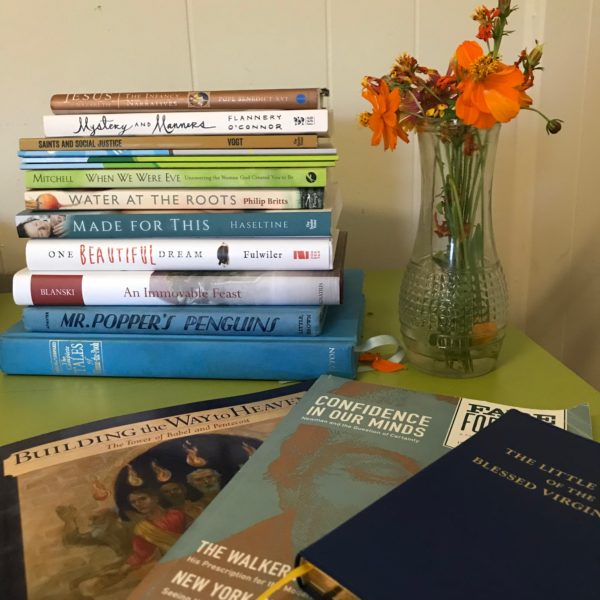
photo-443

I feel pretty glum about the length of my 2012 completed reads. It was a year of sleep-deprivation and pregnancy nausea but I think that if ahead of time I’d had a plan for completing all the books I wanted to finish, maybe I wouldn’t have dropped the ball?

So, to have some accountability, I want to post my reading goals for 2013 and leave a little breathing room for your suggestions (I added several of your recommendations from the comments on my 2012 list from last week! I love having such interesting readers!). It’s not terribly long because there are a few epic classics that are going to take awhile to get through and a new baby is arriving in late May, but I’m trying to add some lighter reading in between the longer classics to keep the momentum going.

Here ’tis!

January

February

March

April

May

June (Hello, Baby Gwen!)

July

August

September

October

November-December: Your Suggestions

Please leave me some comments about what titles you consider to be in the “books to read before you die” category: your very favorite novel of all time, for example. My readers always have the best recommendations! I’m especially interested in your top suggestions for books on homeschooling. I don’t really know where to start!

Anybody have a vote for or against any of the following? I was thinking about adding them:

 What are your reading goals for 2013?

EmailFacebookGoogle ReaderPinterestTumblrTwitterShare

Should You Limit Your Child’s Reading Choices?


I am surprised by the popularity of a post I wrote a few weeks ago: “Why You Can’t Read Twilight: A Letter to My Daughter,” and I’m simply fascinated by some of comments it’s received. Some folks love it, but boy does it rub some people the wrong way!

Many commenters think the idea that I would tell my daughter at say, age 11, that she can’t read Twilight is downright loony and they refer to my daughter’s “right” to read it. Now, I aspire to fight for many rights for my daughter: the right to a loving family, the right to a happy home, the right to a good education, the right to nourishing food, etc. But I guess I just wasn’t familiar with the “right” to read bad novels.

I believe Twilight is a waste of time and poorly written.  And more importantly, it contains unhealthy views of women and relationships that I believe could be detrimental to a young mind’s developing ideas of self, love, and relationships. But I don’t think Twilight is really the issue. The real question is: Is it crazy to not let your child read certain books? Should we, as parents, limit our children’s reading choices?

Many critics of my decision to say “No” to Twilight just hated the idea that I was taking away a choice my daughter might want to make. If only I “trusted” her to make the right decisions, they lament, instead of limiting her choices!  This line of thinking surprised me because limiting choices is simply part of being a parent. Few parents I know would allow their very young children to view R rated movies, for example. As parents, we strive to offer our children good choices that are appropriate for their age and maturity level. We do not offer them choices that we are fully aware are inappropriate or may cause them harm. We might allow our child to make the choice to ride a bike, but we would not allow her to make her own decision about whether or not she wanted to ride on a busy street without a helmet at night. We do not say, “You want to go to the mall instead of school today? Great! I respect your ability to make decisions!” Sorry. As parents, we limit choices. It’s just what we do.

Perhaps a better example is how parents deal with food choices. My 3-year-old son would eat candy for every meal if I recognized his “right” to eat whatever he desired. If I acquiesced to his constant requests for sweets, with the full knowledge that I was causing him physical harm, that he would likely develop diabetes, and that he was missing out on all the nourishing foods his body needs because he was filling up with sugar, I would not be a good mother. And it’s not because I don’t “trust” him. It’s because I know that he is three and that as a young child, the allure of sweets is stronger than his nutritional knowledge and his ability to make great choices regarding food. So, what do I do? When he asks for a treat I offer him good choices: peanut butter and apples, dried fruit, etc. Things that have nutritional value, won’t harm his body, and might partly satiate his desire for a sweet treat. Through offering him these choices rather than junkfood, I am teaching him healthy eating habits he can carry with him through life. So when the day comes when he is making all of those decisions himself, he will have a developed palate for good foods and the knowledge needed to nourish his body well. Does that mean that he won’t ever make bad choices? No. He might eat Cinnamon Toast Crunch for every meal. My concern is doing the task before me well: giving him the right tools he needs to be able to make good decisions about food.

Why isn’t it the same story with books? Do we not really believe that the books we read form us into the people we are? I want to offer beautiful and good literature for my daughter’s developing mind and soul rather than presenting her with the ultimate junkfood of books. In other words, I want to help her develop a taste for good literature. Because I’ve been an 11-year-old girl and—while I’d love to pretend that I had everything figured out as a pre-teenlet’s be honest: I was still forming crucial ideas, particularly about love and relationships. Would I have had the maturity to see through the ridiculousness of Meyer’s series at that age? Doubtful. It’s written to appeal to a fantasy of immature ideas of love. It’s MADE to be enticing to preteens. It’s even enticing to some grown women. Now, does this mean that as a teenager, my daughter won’t be allowed to read it if she really wants to? No. I hope that by that age she would have fallen so in love with good literature that reading Twilight would be an unattractive option to her. But she very well might read it some day. I’m not worried about that. My job is to offer her books that will nourish her developing mind, aren’t a waste of time, and that don’t present her with terrible relationship models during her formative years. If and when she gets her hands on Twilight, she will already be well-versed in truly good literature. And whether she likes Twilight or not, she will at least see its inadequacies.

Some of the other popular arguments for why I should let my children read Twilight are interesting, as well. One argument in their favor claims that the books are entertaining. But, to say that something is entertaining is not to say that it is good or that it is bad. It merely means that it holds your attention. Most parents have some sort of guidelines about what movies their children are allowed to view…and it doesn’t have anything to do with how entertaining the film may or may not be. Others said that reading Twilight is a positive thing because it’s better than just sitting in front of the TV, not reading ever, or reading books like 50 Shades of Grey. So, reading Twilight is better than frying your brain, being illiterate, or reading the most inappropriate book for children that you can think of? Wow! Impressive. Can’t we offer our kids better options than “well, it’s not the worst thing you could do with your time”? Why settle? Another recommendation is that the Twilight series is easy and gets kids reading. Seventeen magazine is easy reading, but nobody’s vouching for it’s literary value or that it spurs young readers on to great heights of literary achievement.

I have been advised by the Twilight fans that my daughter will hate me forever and eternally resent my decision to not let her read Meyer’s literary atrocity as a pre-teen. To be honest…I’m just not really worried about it.

My job as a parent is to do what is best for my children. It would be great if, one day, my daughter were able to fully understand and appreciate every decision I make concerning her. Sure, it would be sad if my daughter resents my decisions. But those decisions are based on well-thought-out reasons and I am not going to change them to satisfy the whims of a child.

Do you think it’s appropriate to limit your child’s reading choices? Join the conversation! 

(This post is linked-up today at The Parent ‘Hood)

EmailFacebookGoogle ReaderPinterestTumblrTwitterShare

Bookshelf Love: Our Library Shelves

Since we started homeschooling our 3-year-old for Preschool our stack of library books has grown by leaps and bounds and started taking over our living room. I saw the idea to use IKEA spice racks as children’s bookshelves that’s so popular on pinterest and mentioned it to my husband. “I can make that,” he said.

He put them together and Benjamin “helped” paint them and now they are lovely and displaying library books in our hallway.

We put them up at a low enough height that Benjamin could reach the first two shelves but high enough that they would be out of reach for Baby Lucy.

I love the pretty embellishment on the front of the shelves.

How do you keep track of your library books? Do you have a designated spot for them?

To see the organization of our bedroom built-in bookshelves, check out:

EmailFacebookGoogle ReaderPinterestTumblrTwitterShare

This Week’s Miscellany: Vol. 23

Coming Up in the Liturgical Year: The Feast of St. Rose of Lima next Thursday! Daniel made an unforgettable meal last year to celebrate with dishes from the Philippines and Peru. We posted both recipes on our severely neglected liturgical year blog: Feast!

In the Garden:

I finally cooked up this Green Cushaw Pumpkin, the biggest thing we’ve ever grown in our garden: Pumpkin and Sausage, Winter Squash bars (Gluten-Free), Lentil and Squash Curry, and Stuffed Squash all with one pumpkin! There’s still pumpkin seeds to be roasted. Mmmmm.

Reading:

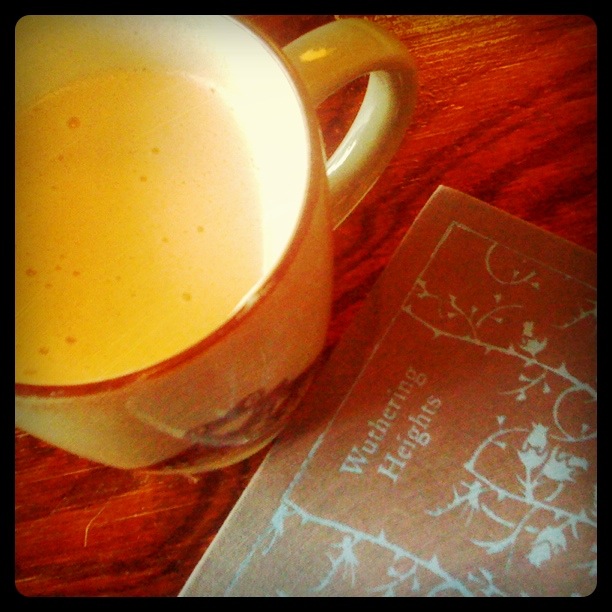
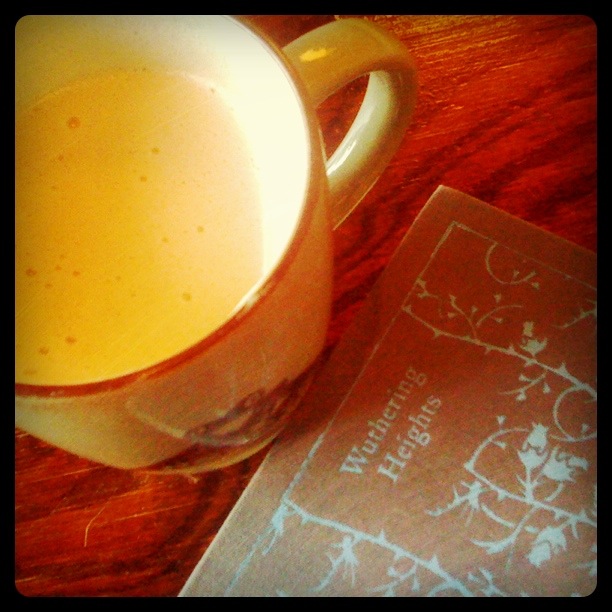
I usually have multiple books going at a time. Right now I’m re-reading Wuthering Heights because I have the most beautiful clothbound edition that was given to me for my birthday last year by Daniel’s sweet parents. Also enjoying Praying with Icons by James Forest. I’m also reading a Russian novel called The Master and Margarita by Bulgakov but I haven’t really fallen in love with it yet. Anybody read it? Worth finishing?

Links:

How Reading Anne of Green Gables Helped Me Chill Out as a Parent: Simple Homeschool (If you’ve been hanging around Carrots for very long, you’re already familiar with my undying love for everything Anne-with-an-e. Loved this post.)

Encouraging Kids to Drink Water: Simple Kids (We haven’t kept juice in the house for several months. It’s so much easier to just offer water and sometimes milk and I know that B isn’t getting tons of sugar from the juice anymore. It also makes special drinks like Bubble Tea and Icy Raspberry Tea all the more exciting for him.)

What Drowning Really Looks Like: Family Your Way (Until reading this, I didn’t know how still and quiet a drowning child appears. Totally terrifying and worth learning about.)

Homeopathy for Morning Sickness and Homepathy for Post Partum Healing: Mama and Baby Love (As a super miserable morning sickness sufferer during pregnancies, I will definitely try some of these remedies if we’re blessed with more pregnancies.)

Escape from Babyland: Simcha Fisher (I love Simcha, as always)

The Quotable Benjamin:

“I don’t like it when you leave my room after you tuck me in. I really feel like I want to put glue in the door so that you have to stay in my room with me forever.”

Instagrams Worth Sharing (If you want to follow me, I’m haleyweasley):

 Little Duckling!

Special Breakfast with Daddy after morning Mass on the Solemnity of the Assumption of the Blessed Virgin. What a treat!

Happy Friday! It’s been a crazy week since I started back teaching ballet and started our unofficial preschool homeschooling with Benjamin. Looking forward to a fun and productive weekend: Thai food date night tonight, working in the garden to prepare the beds for Fall planting, pool party at a friend’s house Saturday, Mass and family breakfast Sunday, and hopefully some reading and writing time for me. Got any fun weekend plans?

EmailFacebookGoogle ReaderPinterestTumblrTwitterShare

Why Your Kids Need to Read Harry Potter

Warning: I’ve tried to be vague and keep spoilers at a minimum, but if you don’t want to know ANYTHING about the plot, be warned that this post contains allusions to themes and plot events.


Confession: I have loved the Potter series since I was 12 years old. I grew up with Rowling’s books and they continue to delight me. I cannot wait until my children are old enough to delve into the enchanting world of Harry Potter. Now, I know some folks take issue with the idea that the characters are wizards. Particularly in conservative Christian circles, the Harry Potter books have been maligned and enraged parents have demanded they be banned from school libraries. This is hard for me to understand. Few modern fictional works are built upon such a strong Christian philosophical framework as Rowling’s books. Your kids need to read them. For the sake of their souls (and I’m only being slightly hyperbolic.)

First, let’s get something out of the way. The main characters are described as wizards. True. And the school they attend is Hogwarts School of Witchcraft and Wizardry. That’s enough for some folks to throw them in the fire right then and there. But, an important distinction needs to be made. Sorcery in these books is not the sort of witchcraft forbidden in Holy Scripture. The wizards in Harry Potter do not invoke evil spirits or dark forces in order to change the physical world. Rather, they possess a genetic capability, like a superpower. No one seems to have objections to Tolkien’s Gandalf although he is a self-described wizard. For a more in depth explanation of the differences between witchcraft as defined in the Catechism of the Catholic Church and the sort of magic in Harry Potter, please read Karen Edmisten’s excellent post.

Now that that’s out of the way, why is it so important that your children read this series? The Harry Potter books have many virtues including a high view of the family, strong female characters, and an Aristotelian view of friendship, but I want my children to read them because as humans we learn through stories. And these stories reveal an exaltation of virtue, an orthodox view of evil, a courageous view of self-sacrificial death, and a portrayal of the beauty and strength of love.

Themes of Christian virtue carry Rowling’s characters through the tale. Bravery, loyalty, self-sacrifice, compassion; these are all presented as important traits to be sought after. Now, that’s not to say that the characters never make mistakes. Indeed, the main characters lie, abandon friends in need, and neglect their families among other grave errors. But, it is clear when they transgress that they have done wrong and they suffer the consequences. There are no morally ambiguous or warped characters that you find yourself rooting for.  This is where the Potter books differ greatly from some other fantasy works such as the His Dark Materials trilogy by Philip Pullman.  Lyra, the main character of Pullman’s books, has an extraordinary ability to lie without detection, a skill from which she benefits and which is viewed as a positive trait. Rowling’s series has you cheering her characters on toward virtue. No one can help loving Ron and when he really fails his friends in The Deathly Hallows, it truly breaks your heart because you so dearly wanted him to do the right thing. When he makes amends, his redemption is splendid. The characters may be flawed, but the stories make the path of virtue clear.

Like Tolkien, Rowling’s depiction of evil is incredibly Augustinian. Early Church father St. Augustine defines evil as a perversion of the good. He also emphasizes that evil is not an equal match of the Good, but far weaker. As something good becomes twisted and warped, it moves closer to nonbeing. Lord Voldemort is really a perfect example of this. As he becomes more deeply entrenched in evil, he becomes less and less human, less and less alive. The acts of murder and cruelty he carries out literally tear apart his soul making his being less whole. He is a shadow of a man. The quest for power without goodness is truly a journey toward pathetic and grotesque brokenness as is portrayed in the King’s Cross chapter in The Deathly Hallows when Harry is face to face with a visual depiction of Voldemort’s soul. Like the White Witch in Lewis’ The Lion, the Witch, and the Wardrobe, evil according to the Potter books cannot even comprehend the great strength of love and is ultimately destroyed by it.

Indeed, Rowling’s works understand that love is the strongest magic of all and evil crumbles before it. Harry’s headmaster, Albus Dumbledore, explains this truth repeatedly. We can only be truly human and truly ourselves if we love, the story teaches. If we can live out self-sacrificial love, like Harry’s parents Lily and James, Harry himself, Dumbledore, and the numerous other characters willing to give their lives for those they love, we have already overcome. Sound familiar? Greater love hath no man than this, that a man lay down his life for his friends (John 15:13).

And that brings us to a theme that Rowling returns to again and again: death. Rowling began writing the Harry Potter books as a way to process her own mother’s death and the very first chapter of the book reveals that Harry’s mother and father have been murdered, leaving him an orphan. The way Rowling deals with death in the series is just so….well, Christian. Firstly, the tales emphasizes that death is not the end. No, indeed. In fact, on Harry’s parents tombstone is the verse, “The last enemy to be destroyed is death” (1 Corinthians 15:26). Also, although death is a complex and difficult reality, it is not presented as something to fear. There are worse things than dying, the story shows us, such as destroying one’s soul through submission to evil. Giving up your life in order to save those you love is an unbeatable “magic “of incalculable power. In the end, evil is conquered by an act of ultimate sacrifice. Love and death are intricately connected. But love, as Rowling’s story shows us, is stronger than death.

I firmly believe that every parent should be closely involved with the books and ideas their children are presented with. So read the Harry Potter books. And if you find them as compelling as I do, share them with your kids.

If you enjoyed this post you might also enjoy: 10 Books You Must Read to Your Daughter (Or, How to Keep Your Daughter from Ending Up Like that Horrid Girl in Twilight). This post may contain Amazon affiliate links.


EmailFacebookGoogle ReaderPinterestTumblrTwitterShare

20 Picture Books That Will Delight Your Children (And That Won’t Annoy You)
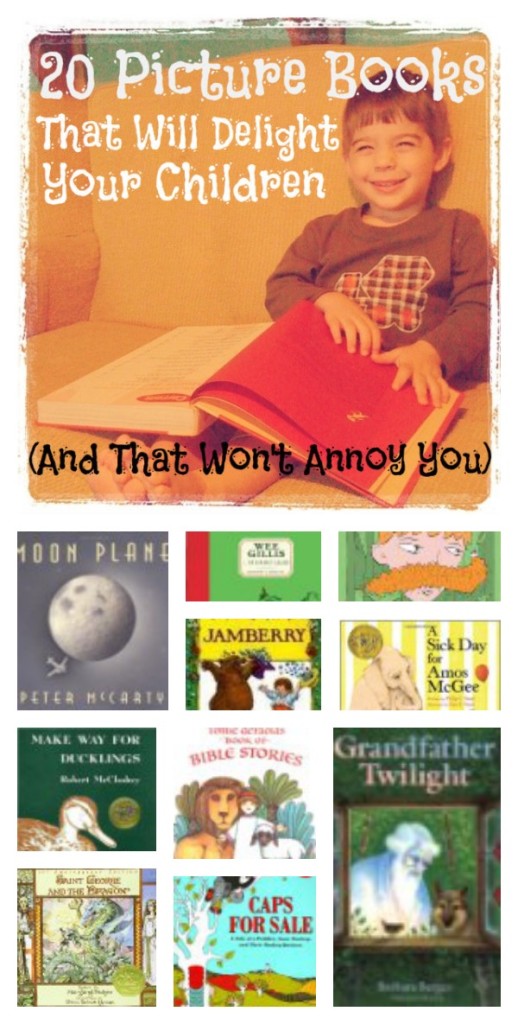
If you share our family’s addiction to books, you might face the same perpetual dilemma of never having enough bookshelves to house the titles that become beloved friends. This list won’t help you with that problem at all. These are some tried and true titles that have passed an important test: we’ve read them hundreds of times to our 3-year-old and don’t hate them yet (miraculous, no!?). The stories and illustrations of these books are enchanting and they have become classics in our household. Enjoy our list and may your bookshelves always overflow!

1. Where the Wild Things Are by Maurice Sendak

2. Tomie dePaola’s Book of Bible Stories (I can’t get enough of dePaola! Strega Nona is another beloved title at our house.)

3. Caps for Sale: A Tale of a Peddler, Some Monkeys, and Their Monkey Business by Esphyr Slobodkina

4. Saint George and the Dragon by Margaret Hodges (Illustrated by Trina Schart Hyman)

5. Mike Mulligan and His Steam Shovel by Virginia Lee Burton (We also love The Little House by the same author)

6. Wee Gillis By Munro Leaf (Illustrated by Robert Lawson)

7. Moon Plane by Peter McCarty

8. Make Way for Ducklings by Robert McCloskey (We also adore Blueberries for Sal.)

9. Ox-Cart Man by Donald Hall (Illustrated by Barbara Cooney)

10. Goldilocks and the Three Bears by Jan Brett (Haven’t found a Jan Brett book that I don’t like. The illustrations are always so intricate and stunning. Trouble with Trolls is another classic.)

11. A Sick Day for Amos McGee by Philip C. Steed (Illustrated by Erin E. Steed)

12. Corduroy by Don Freeman

13. Giant Treasury of Peter Rabbit: Tales by Beatrix Potter

14. The Giving Tree by Shel Silverstein

15. A Color of His Own by Leo Lionno

16. Grandfather Twilight by Barbara Berger

17. Your Favorite Seuss: 13 Stories by Dr. Seuss

18. A Seed is Sleepy by Dianna Hutts Aston (Illustrated by Sylvia Long)

19. Jamberry by Bruce Degen

20. The Complete Tales of Winnie-the-Pooh by A. A. Milne

What picture books have you enjoyed even after a hundred readings? What would you add to the list?

If you enjoyed this post, you might also enjoy 10 Books You Must Read to Your Daughter (Or How to Keep Your Daughter from Ending Up Like That Horrid Girl in Twilight) and 10 Books You Must Read to Your Son.

(This post contains Amazon Affiliate links. Thank you for supporting our family’s love for reading.)

EmailFacebookGoogle ReaderPinterestTumblrTwitterShare

January 2012 Reads

Now that we’re really settled into life with two kids, my sleep-deprived mind is getting back into the swing of reading for pleasure.

In January I finally finished Cranford by Elizabeth Gaskell. It was a beautiful clothbound Penguin edition, see?

I am more than mildly obsessed with these Penguin editions and my wonderful in-laws gifted me several for my birthday last year. Can’t imagine a better gift. Cranford was my first Elizabeth Gaskell. I loved the miniseries with Judi Dench and honestly, although the book was delightful…(I’m scared to say it) I kind of liked the film better. Don’t tar and feather me. Cranford doesn’t read as a novel so much as a collection of vignettes. It’s charming but I think I will like North and South or Wives and Daughters better in book form.

And while we’re on the subject of the clothbound Penguin classics, this is the coolest phone charger imaginable:

Thanks to Cassie for alerting me that such things exist.

I also finished Stephen Lawhead’s Arthur. I can’t say no to Arthurian related books. I didn’t like Arthur as much as the first book in the series, Taliesin. But it was still worth reading and I’ll probably track down the final two books. It’s actually well-researched and not as embarrassing as the cover art would lead you to believe.

During my Holy Hour I started reading the Blessed John Paul II’s Encyclical Familiaris Consortio: On the Christian Family in the Modern World. It’s as wonderful as I expected.

And every morning I treat myself to the day’s reading in Karen Edmisten’s Through the Year with Mary. Sometimes I forget and the next day I treat myself to TWO wonderful quotes about Our Lady.

Benjamin has recently made a leap in his reading time attention span and has been enjoying Dr. Seuss in particular. He can sit through several stories in a row and beg for more.

What have you been reading? What are your kids enjoying?

EmailFacebookGoogle ReaderPinterestTumblrTwitterShare

10 Books You Must Read to Your Son

After 10 Books You Must Read to Your Daughter, I thought the boys were getting rather left out. Having never been a boy, this list didn’t come as naturally. But, being the mother of a boy it seems equally important. Basically, I want my son to be a confident, thoughtful, compassionate, strong-minded, and virtuous man like Mr. Knightley, not a weak, desire-driven, selfish cad like Willoughby. So here goes (with some help from Daniel)…

1. The Once and Future King by T.H. White: I cannot wait to read this to Benjamin. This retelling of the King Arthur story is delightful and full of important questions of honor, justice, and manhood. Also, there’s adventure galore and falconry. So, what more could you want?

2. The Lord of the Rings by J.R.R. Tolkien: The Lord of the Rings is the foundation for a huge amount of modern fantasy literature, movies and video games.  It would not be exaggerating to say that even the genre of “fantasy” became nearly synonymous with the general aspects of Tolkien’s world. Beyond the fantasy genre, LotR has influenced everything from Harry Potter to Star Wars. Despite this far reaching influence, Tolkien’s imagined world remains unmatched in depth, history, richness, and detail. But more important than all of this, The Lord of the Rings teaches virtue in an incredibly powerful way. Of course, there is Aragorn; wise, strong, courageous, and skilled in warfare. But, despite what the LotR movies would have you believe, Tolkien was not enamored with war. Battles make up a very small percentage of his books and he does not romanticize fighting.  The true heroes, Sam and Frodo, are neither physically strong or all that knowledgeable and they spend almost no time engaged in any sort of physical combat. Their great feat is their faithfulness to the task given to them, their courage in the face of overwhelming odds, and their willingness to sacrifice their own lives for others.

3. Beowulf: Get yourself the Seamus Heaney translation and introduce your son to some epic Anglo-Saxon manhood. There are dragons, monsters, and really strong guys who can rip monsters apart with their hands. But it’s not really about brawn, it’s about honor, courage, responsibility, and sacrifice.

4. The Iliad by Homer: Just in case Beowulf didn’t thoroughly saturate your kid with epic poetry, read him the Iliad. It’s kind of a classic.

5. The Yearling by Marjorie Kinnan Rawlings: I’m not a huge fan of the YA Fiction “coming of age” story, but this one is pure gold. On the surface, this Pulitzer Prize winning novel follows Jody Baxter, a young boy living in backwoodsy Florida, and his friendship with a deer, but there are deeper themes of family, sacrifice, and the painful process of growing up. There are enough bear hunts and snake bites to keep any boy’s attention but this fine novel can wring tears from a grown man.

6. Anything Jane Austen: I know, I know, you think they’re just for girls, but you’re wrong. The heroes of Austen’s six novels don’t slay dragons or hunt bears but they are fighting everyday battles of self-sacrifice, honor, and compassion. I hope Benjamin grows up to be a chivalrous Mr. Knightley or a noble Colonel Brandon and I want him to understand the consequences of acting like a rakish Willoughby, Henry Crawford, or Wickham: everything gets ruined, especially the cad’s own soul. These novels aren’t about weddings, they’re about virtue. A thorough knowledge of Miss Austen’s novels also won’t hurt a young man’s ability to win the heart of his lady love.

7. The Harry Potter series by J.K. Rowling: It’s no secret that these books are favorites in the Stewart household. When I was pregnant with our firstborn I said to Daniel in a horrorstruck voice, “What if our kids don’t like Harry Potter?!” We decided to just dismiss the thought because it’s too ghastly to consider. So, many fine male characters, friendship Aristotle would approve of, a view of evil that’s thoroughly Augustinian, beautiful depictions of sacrificial love, and a high view of family are just a few things that the series has to offer.

8. The Chronicles of Narnia by C.S. Lewis: First of all, I can’t believe I left this series off the girl’s list. They’re worthy of a place in every kid’s childhood. Benjamin’s almost three and I really want to give these wonderful books a try for reading aloud at bedtime.

9. The Boy Scouts Handbook: Daniel tells me that an old-timey version of this book about gaining cool skills was one of his favorites as a child. I think it’s important for young boys (and girls) to be outdoorsy savvy.

10. Moby Dick by Herman Melville: OK, so I should confess that I haven’t read this one, but Daniel wrote his thesis on it and says it’s a must read, so it makes the list. The theme of Man vs. Nature is sure to appeal to your young man and the book also includes ships, whales, and sharp objects. Most boys really like the idea of going into the wild and being tested by the forces of nature, or at least that’s what I’m told.

Here’s some more titles highly recommended to me that I didn’t include in the list because it’s been too long since Daniel or I have read them: Hatchet by Gary Paulsen (more man vs. nature), The Three Musketeers by Alexandre Dumas (The Count of Montecristo is also really great), Huckleberry Finn and Tom Sawyer by Mark Twain, and Treasure Island by Robert Louis Stevenson.

Got any suggestions? What would be on your list?

(The links are amazon affiliate links. If you choose to purchase a book from my affiliate link, I will receive a small percentage of the sale. Thanks for supporting me!)

EmailFacebookGoogle ReaderPinterestTumblrTwitterShare