Tag Archives: Harry Potter

8 Reasons Molly Weasley Is a Great Literary Mama

Since becoming a mother, I read my favorite children’s books with different eyes. I find myself more interested in Marmee than Jo March and more fascinated by Caroline Ingalls than by Laura. One of my favorite mamas from literature is Molly Weasley. But what exactly makes this stay-at-home mom of seven so admirable? I’m sharing why I think she’s so great in honor of Mother’s Day coming up this Sunday:

(Note well! Spoilers within!)

1. She opens her heart. Although she loves her children fiercely, Molly’s motherly affection isn’t confined to her immediate family. She thoughtfully considers “the odd one out.” Whether it’s throwing a birthday party for the orphaned Harry Potter, or sharing a spot of tea and wise advice to the awkward and lovelorn Nymphadora Tonks, Molly always seems to notice and fill the need to be loved and cared about. She’s a mama to anyone that needs one.

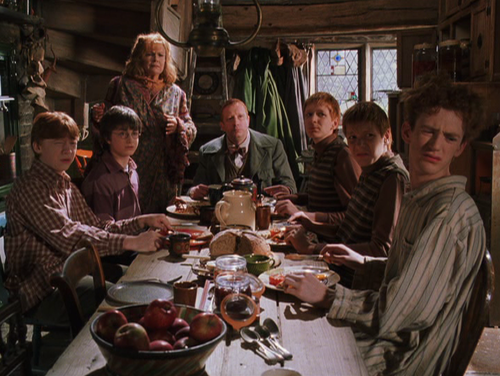
2. She opens her home. Molly excels at hospitality. One of the things I’ve always admired in my own mother is her commitment to open her home. Molly Weasley does the same. She bustles around tirelessly, sharing her delicious food and motherly affection. When I read about her culinary accomplishments, I can’t help but wish I were sitting at her kitchen table, chatting with her and helping her chop veggies (with my magic wand, of course.)

3. She has an abundance of skills she uses for the good of her family. She cares for her family so well that her son Ron assumes she can make tasty food from thin air (an impossibility in the wizarding world). Although she’s fantastic at domestic spells, they aren’t her only claim to fame. As is revealed in the final book of the series, Molly can best one of the most prodigiously talented women in the wizarding world in a duel without batting an eye–when her only daughter is in danger! She’s a talented woman and she uses her skills to love and protect her family.

4. Her deep love isn’t self-centered. She gives tight hugs and knits her loved ones sweaters every Christmas. She constantly worries about the safety of her family (remember the boggart in Order of the Phoenix?). Yet, she encourages her children to do the right thing–even if it means they will be in danger. Although she sometimes errs on the side of overprotection (I certainly sympathize, Molly!), she believes that fighting for a better world is more important than safety. Maybe when one of your six sons works with dragons, another is a curse breaker, and several family members are in the movement to fight the world’s most evil wizard, you get used to the anxiety!

5. She pushes her kids to grow. When her kids do really dumb things, she lets them know. Steal dad’s flying car and get spotted by muggles? You’re going to receive a howler. Don’t study for your O.W.L.s and get low marks? She knows you can do better and she’s not afraid to make her opinion known! But…

6. She cheers her kids on. Get chosen as a school prefect and you can expect Molly to throw a party. Show the world you’re adept at a career even she was skeptical of? She’ll sing your praises. And she’ll work her fingers to the bone to give you an amazing wedding, even if your choice of bride isn’t the sort of girl she had in mind.

7. She loves her husband. Although they sometimes passionately disagree, Molly and Arthur love and respect each other. She is his biggest fan and can’t wait to proclaim his accomplishments. She believes in him despite his quirks, instead of wishing he were more financially successful…and less interested in muggle artifacts.

8. She cheerfully makes do with what she has. Although the Weasleys are often under financial strain, Molly doesn’t complain about their situation. I know how it is to run a household on one income and I’m always inspired by her resourceful and positive attitude even when times are tough. She knows the real treasures in life are her children and isn’t that so true?

Happy Mother’s Day, Molly! Do you have a favorite literary mom? What makes her admirable?

EmailFacebookGoogle ReaderPinterestTumblrTwitterShare

Why Your Kids Need to Read Harry Potter

Warning: I’ve tried to be vague and keep spoilers at a minimum, but if you don’t want to know ANYTHING about the plot, be warned that this post contains allusions to themes and plot events.


Confession: I have loved the Potter series since I was 12 years old. I grew up with Rowling’s books and they continue to delight me. I cannot wait until my children are old enough to delve into the enchanting world of Harry Potter. Now, I know some folks take issue with the idea that the characters are wizards. Particularly in conservative Christian circles, the Harry Potter books have been maligned and enraged parents have demanded they be banned from school libraries. This is hard for me to understand. Few modern fictional works are built upon such a strong Christian philosophical framework as Rowling’s books. Your kids need to read them. For the sake of their souls (and I’m only being slightly hyperbolic.)

First, let’s get something out of the way. The main characters are described as wizards. True. And the school they attend is Hogwarts School of Witchcraft and Wizardry. That’s enough for some folks to throw them in the fire right then and there. But, an important distinction needs to be made. Sorcery in these books is not the sort of witchcraft forbidden in Holy Scripture. The wizards in Harry Potter do not invoke evil spirits or dark forces in order to change the physical world. Rather, they possess a genetic capability, like a superpower. No one seems to have objections to Tolkien’s Gandalf although he is a self-described wizard. For a more in depth explanation of the differences between witchcraft as defined in the Catechism of the Catholic Church and the sort of magic in Harry Potter, please read Karen Edmisten’s excellent post.

Now that that’s out of the way, why is it so important that your children read this series? The Harry Potter books have many virtues including a high view of the family, strong female characters, and an Aristotelian view of friendship, but I want my children to read them because as humans we learn through stories. And these stories reveal an exaltation of virtue, an orthodox view of evil, a courageous view of self-sacrificial death, and a portrayal of the beauty and strength of love.

Themes of Christian virtue carry Rowling’s characters through the tale. Bravery, loyalty, self-sacrifice, compassion; these are all presented as important traits to be sought after. Now, that’s not to say that the characters never make mistakes. Indeed, the main characters lie, abandon friends in need, and neglect their families among other grave errors. But, it is clear when they transgress that they have done wrong and they suffer the consequences. There are no morally ambiguous or warped characters that you find yourself rooting for.  This is where the Potter books differ greatly from some other fantasy works such as the His Dark Materials trilogy by Philip Pullman.  Lyra, the main character of Pullman’s books, has an extraordinary ability to lie without detection, a skill from which she benefits and which is viewed as a positive trait. Rowling’s series has you cheering her characters on toward virtue. No one can help loving Ron and when he really fails his friends in The Deathly Hallows, it truly breaks your heart because you so dearly wanted him to do the right thing. When he makes amends, his redemption is splendid. The characters may be flawed, but the stories make the path of virtue clear.

Like Tolkien, Rowling’s depiction of evil is incredibly Augustinian. Early Church father St. Augustine defines evil as a perversion of the good. He also emphasizes that evil is not an equal match of the Good, but far weaker. As something good becomes twisted and warped, it moves closer to nonbeing. Lord Voldemort is really a perfect example of this. As he becomes more deeply entrenched in evil, he becomes less and less human, less and less alive. The acts of murder and cruelty he carries out literally tear apart his soul making his being less whole. He is a shadow of a man. The quest for power without goodness is truly a journey toward pathetic and grotesque brokenness as is portrayed in the King’s Cross chapter in The Deathly Hallows when Harry is face to face with a visual depiction of Voldemort’s soul. Like the White Witch in Lewis’ The Lion, the Witch, and the Wardrobe, evil according to the Potter books cannot even comprehend the great strength of love and is ultimately destroyed by it.

Indeed, Rowling’s works understand that love is the strongest magic of all and evil crumbles before it. Harry’s headmaster, Albus Dumbledore, explains this truth repeatedly. We can only be truly human and truly ourselves if we love, the story teaches. If we can live out self-sacrificial love, like Harry’s parents Lily and James, Harry himself, Dumbledore, and the numerous other characters willing to give their lives for those they love, we have already overcome. Sound familiar? Greater love hath no man than this, that a man lay down his life for his friends (John 15:13).

And that brings us to a theme that Rowling returns to again and again: death. Rowling began writing the Harry Potter books as a way to process her own mother’s death and the very first chapter of the book reveals that Harry’s mother and father have been murdered, leaving him an orphan. The way Rowling deals with death in the series is just so….well, Christian. Firstly, the tales emphasizes that death is not the end. No, indeed. In fact, on Harry’s parents tombstone is the verse, “The last enemy to be destroyed is death” (1 Corinthians 15:26). Also, although death is a complex and difficult reality, it is not presented as something to fear. There are worse things than dying, the story shows us, such as destroying one’s soul through submission to evil. Giving up your life in order to save those you love is an unbeatable “magic “of incalculable power. In the end, evil is conquered by an act of ultimate sacrifice. Love and death are intricately connected. But love, as Rowling’s story shows us, is stronger than death.

I firmly believe that every parent should be closely involved with the books and ideas their children are presented with. So read the Harry Potter books. And if you find them as compelling as I do, share them with your kids.

If you enjoyed this post you might also enjoy: 10 Books You Must Read to Your Daughter (Or, How to Keep Your Daughter from Ending Up Like that Horrid Girl in Twilight). This post may contain Amazon affiliate links.


EmailFacebookGoogle ReaderPinterestTumblrTwitterShare

10 Books You Must Read to Your Son

After 10 Books You Must Read to Your Daughter, I thought the boys were getting rather left out. Having never been a boy, this list didn’t come as naturally. But, being the mother of a boy it seems equally important. Basically, I want my son to be a confident, thoughtful, compassionate, strong-minded, and virtuous man like Mr. Knightley, not a weak, desire-driven, selfish cad like Willoughby. So here goes (with some help from Daniel)…

1. The Once and Future King by T.H. White: I cannot wait to read this to Benjamin. This retelling of the King Arthur story is delightful and full of important questions of honor, justice, and manhood. Also, there’s adventure galore and falconry. So, what more could you want?

2. The Lord of the Rings by J.R.R. Tolkien: The Lord of the Rings is the foundation for a huge amount of modern fantasy literature, movies and video games.  It would not be exaggerating to say that even the genre of “fantasy” became nearly synonymous with the general aspects of Tolkien’s world. Beyond the fantasy genre, LotR has influenced everything from Harry Potter to Star Wars. Despite this far reaching influence, Tolkien’s imagined world remains unmatched in depth, history, richness, and detail. But more important than all of this, The Lord of the Rings teaches virtue in an incredibly powerful way. Of course, there is Aragorn; wise, strong, courageous, and skilled in warfare. But, despite what the LotR movies would have you believe, Tolkien was not enamored with war. Battles make up a very small percentage of his books and he does not romanticize fighting.  The true heroes, Sam and Frodo, are neither physically strong or all that knowledgeable and they spend almost no time engaged in any sort of physical combat. Their great feat is their faithfulness to the task given to them, their courage in the face of overwhelming odds, and their willingness to sacrifice their own lives for others.

3. Beowulf: Get yourself the Seamus Heaney translation and introduce your son to some epic Anglo-Saxon manhood. There are dragons, monsters, and really strong guys who can rip monsters apart with their hands. But it’s not really about brawn, it’s about honor, courage, responsibility, and sacrifice.

4. The Iliad by Homer: Just in case Beowulf didn’t thoroughly saturate your kid with epic poetry, read him the Iliad. It’s kind of a classic.

5. The Yearling by Marjorie Kinnan Rawlings: I’m not a huge fan of the YA Fiction “coming of age” story, but this one is pure gold. On the surface, this Pulitzer Prize winning novel follows Jody Baxter, a young boy living in backwoodsy Florida, and his friendship with a deer, but there are deeper themes of family, sacrifice, and the painful process of growing up. There are enough bear hunts and snake bites to keep any boy’s attention but this fine novel can wring tears from a grown man.

6. Anything Jane Austen: I know, I know, you think they’re just for girls, but you’re wrong. The heroes of Austen’s six novels don’t slay dragons or hunt bears but they are fighting everyday battles of self-sacrifice, honor, and compassion. I hope Benjamin grows up to be a chivalrous Mr. Knightley or a noble Colonel Brandon and I want him to understand the consequences of acting like a rakish Willoughby, Henry Crawford, or Wickham: everything gets ruined, especially the cad’s own soul. These novels aren’t about weddings, they’re about virtue. A thorough knowledge of Miss Austen’s novels also won’t hurt a young man’s ability to win the heart of his lady love.

7. The Harry Potter series by J.K. Rowling: It’s no secret that these books are favorites in the Stewart household. When I was pregnant with our firstborn I said to Daniel in a horrorstruck voice, “What if our kids don’t like Harry Potter?!” We decided to just dismiss the thought because it’s too ghastly to consider. So, many fine male characters, friendship Aristotle would approve of, a view of evil that’s thoroughly Augustinian, beautiful depictions of sacrificial love, and a high view of family are just a few things that the series has to offer.

8. The Chronicles of Narnia by C.S. Lewis: First of all, I can’t believe I left this series off the girl’s list. They’re worthy of a place in every kid’s childhood. Benjamin’s almost three and I really want to give these wonderful books a try for reading aloud at bedtime.

9. The Boy Scouts Handbook: Daniel tells me that an old-timey version of this book about gaining cool skills was one of his favorites as a child. I think it’s important for young boys (and girls) to be outdoorsy savvy.

10. Moby Dick by Herman Melville: OK, so I should confess that I haven’t read this one, but Daniel wrote his thesis on it and says it’s a must read, so it makes the list. The theme of Man vs. Nature is sure to appeal to your young man and the book also includes ships, whales, and sharp objects. Most boys really like the idea of going into the wild and being tested by the forces of nature, or at least that’s what I’m told.

Here’s some more titles highly recommended to me that I didn’t include in the list because it’s been too long since Daniel or I have read them: Hatchet by Gary Paulsen (more man vs. nature), The Three Musketeers by Alexandre Dumas (The Count of Montecristo is also really great), Huckleberry Finn and Tom Sawyer by Mark Twain, and Treasure Island by Robert Louis Stevenson.

Got any suggestions? What would be on your list?

(The links are amazon affiliate links. If you choose to purchase a book from my affiliate link, I will receive a small percentage of the sale. Thanks for supporting me!)

EmailFacebookGoogle ReaderPinterestTumblrTwitterShare

10 Books You Must Read to Your Daughter (Or How to Keep Your Daughter From Ending Up Like That Horrid Girl in Twilight)

So now we have a baby daughter. Look how she slumbers. She doesn’t even know that I stay up at night worrying about her self-image. And, oh horrors! What if someday she wants to read Stephanie Meyer’s literary atrocity, the Twilight series? You know the one, the books featuring a non-descript female protagonist who, in addition to having no interests or talents of any kind (other than smelling delicious to a sparkly 100-year-old vampire), is helpless, boring, and basically suicidal when her 100-year-old sparkly vampire boyfriend breaks up with her? Yeah, those books. So, I’m coming up with a reading list containing female characters that could put a smack down on Bella Swan any day of the week and reveal what a real woman looks like.

1. The Anne Books by Lucy Maud Montgomery: Anne of Green Gables and the 7 sequels that complete the series were a staple of my childhood. Anne is fantastic. She’s clever, charming, resourceful, imaginative (to a fault), and hysterically funny. And she goes to college and gets a BA during the Edwardian era. So that’s impressive. I actually saw the miniseries first and read the books later. IMPORTANT: Anne of Green Gables the film and Anne of Green Gables the sequel (Anne of Avonlea) are wonderful but for Pete’s sake DO NOT watch Anne the Continuing Story. Pretend it doesn’t exist. It’s an absurd and wretched thing that dishonors the very name of Anne. Really. Part of you will die.

2. The Little House Series by Laura Ingalls Wilder: I was probably a little too obsessed with the Little House books in my day. I may or may not have worn lace-up black boots, braids, and read under an old-timey quilt next to an antique hurricane lamp most of the time between the ages of 6 and 8. File this one under the category of “capable women doing cool stuff.” Laura Ingalls is awesome, obvi.

3. Little Women by Louisa May Alcott: I have a distinct memory of finishing the last pages of Louisa May Alcott’s finest mere minutes before heading to the theatre to see the 1994 film on Christmas Day with my mom. What girl doesn’t adore the awkward and gutsy Jo March? I have to confess though that when I read it last year I realized I’m probably more like Amy—not because I have the slightest visual artistic talent but because we’re both selfish. I love that each of the four sisters are so different and yet each one exudes a positive kind of femininity, although, to be fair, Meg’s “I-don’t-worry-my-pretty-little-head-about-it” attitude isn’t quite what I have in mind for my daughter. Warning: after reading this I was rather bitter that I didn’t have sisters. Just a heads up.

4. The Harry Potter series by J.K. Rowling: You’d be hard pressed to find a book series with better female characters. There’s a quote swimming around the internet attributed to Stephen King: “Harry Potter is about confronting fears, finding inner strength and doing what is right in the face of adversity. Twilight is about how important it is to have a boyfriend.” I concur. I love that Rowling can depict a strong, brave, capable, intelligent, and compassionate woman in such a variety of characters: a middle-aged stay-at-home mom of seven, a pink-haired dark wizard catcher, an elderly spinster teacher, and an overachieving teenaged student, to name a few.  If my girl emulates Hermione Granger, Luna Lovegood, Ginny Weasley, Nymphadora Tonks, Minerva McGonagal, or, of course, my beloved Molly Weasley, I’ll be a happy mama. And it doesn’t hurt that the whole plot pivots around the sacrifice of one amazing mother (Lily Potter) for her son. Anyone who’s down on these books can’t have read them.

5. Till We Have Faces by C.S. Lewis: This complex book is a retelling of the Cupid and Psyche myth and Orual, the main character (Psyche’s older unattractive sister), is an incredibly complex character. It’s not so much that Orual should be a role model, but her spiritual journey is worth reading and the book is sure to lead to some good discussions about what a good woman should be. It’s notable that Lewis had lots of help from his wife, Joy Davidman, when writing this book. Otherwise, it’s hard to imagine how a man could be so amazingly insightful about a woman’s mind.

6. The Lord of the Rings by J.R.R. Tolkien: OK, so definitely not a girlie book (not that any book in this list has an exclusively female audience), and there’s very few female characters. However, the ones it depicts are fantastic. Galadriel? Eowyn? Yes, please. The book also exudes so many virtues that it seems hardly possible that having completed it your daughter will care two cents about Stephanie Whats-Her-Name. See? I can’t even remember because I’ve read Lord of the Rings. Also, it’s full of real men which is an important thing for a girl to be able to recognize. I’ll take Faramir, thanks.

7. Anything Jane Austen wrote: Want your daughter to know a thing or two about interesting women? Read all six of these novels to her. After reading them, one should know exactly what kind of woman to be and what kind of woman to avoid. Elizabeth Bennet has more clever things to say in one page of P&P than Bella Swan could mumble in her entire miserable existence. And none of Austen’s heroine’s decide to curl up and die when they’re “crossed in love.” Philosopher Alasdair McIntyre supposedly said, “I don’t trust anyone who doesn’t like Jane Austen.” I quite agree.

8. Jane Eyre by Charlotte Bronte: A plain little orphan stands up to terrible relatives, survives a childhood of neglect and abuse, strengthens her mind with education, is the intellectual match of one of the most imposing and fascinating male characters in British literature, and makes the prettiest girl in the county look like a spineless nothing in comparison, among other impressive exploits. Supposedly, Charlotte Bronte bet her sisters (and fellow authoresses) that she could write a successful novel around a female character that was neither pretty nor charming. She won, obvi.

9. A Girl of the Limberlost by Gene Stratton Porter: Lesser-known book published in 1909, but a real treat. Stratton-Porter’s main character, Elnora Comstock, is so wonderful and endearing. Also she collects moths, so that’s cool (or at least Phillip Ammon thinks so). The prequel, Freckles, is also charming and delightful.

10. Kristin Lavransdatter by Sigrid Undset: This three-part saga by Norwegian author Sigrid Undset won the Nobel prize for literature and is one of the finest works you will ever read with a female protagonist rarely paralleled. Kristin is an amazingly human character with as much depth as any female literary character I have encountered. Her spiritual journey is fascinating and the saga is set in 11th century Scandanavia which makes it way more awesome to my medieval-loving heart. However, there are some sexual themes which might make it inappropriate for younger girls. Absolutely worth reading and discussing.

At three months, I don’t think Baby Lucy is ready to dive into these, yet. In the mean time, this mama will be praying lots of rosaries. Anybody else have so many more worries about raising a girl?

Did I leave anything out? What are your recommendations? Any advice on how to raise strong, capable, intelligent, compassionate, confident women? I’m all ears…

If you enjoyed this post you might also be interested in 10 Books You Must Read to Your Son and 20 Picture Books That Will Delight Your Children (And That Won’t Annoy You).

This post contains Amazon affiliate links.

EmailFacebookGoogle ReaderPinterestTumblrTwitterShare

Hogwarts (Finally!)

Last week Daniel took me on a little getaway to the Wizarding World of Harry Potter–a vacation we’ve wanted to take since the park opened. We were all geared up to go last January but postponed our trip when we discovered I was pregnant with Lucy and couldn’t go on any of the rides.

Anyhow it was delightful. The Hogwarts ride is pretty awesome and it’s great fun to meander through Hogsmeade.

I think the best part for us was just hanging out in the Hog’s Head. I had cider and Daniel had their house beer which was great.

We had lunch in the Three Broomsticks which looks fantastic but the staff and the food were less than ideal (well…the turkey leg was awesome, but the cornish pasties tasted like hot pockets.) It was really hard not to say constantly, “Disney would have done this so much better.” I mean, how hard is it to have staff with British accents?

But, we did have a wonderful time together and Lucy was the best little traveler.

One great thing about Universal is that they have a fantastic child-swap system. One parent can ride while the other holds baby and then the second parent can ride as soon as the first is done. And the little waiting rooms are great for nursing.

I just wore her in the baby wrap all day and she napped great. She was fast asleep outside of Owl Post.

I guess I was just a little disappointed that Dame Maggie Smith wasn’t there ready to teach me Transfiguration.

EmailFacebookGoogle ReaderPinterestTumblrTwitterShare