Tag Archives: faith

Women Speak on NFP: When Natural Family Planning Doesn’t Go According to Your Plan


This is a guest post by Christy of fountains of home in the Women Speak on NFP series. In this series you will hear from women using various methods of NFP, some to avoid pregnancy, some trying to conceive, and their experiences.

Disclaimer: This series is not meant to be a substitute for any method of training in NFP! If you are interested in one of the methods introduced in this series, please contact a certified instructor for information about training in that method of NFP. 

Natural family planning, and the science and research behind it, has come a long way in the last 50 years. The effectiveness of the major methods when followed correctly approach 95-99%. But what happens when natural family planning is difficult or ineffective for a woman? When no confidence or trust can be found in a woman’s charting and cycle in regards to avoiding pregnancy the ramifications can touch almost every part of her and her husband’s life. The self-sacrifice usually required by natural family planning can become momentous and a heroic act of virtue. God’s will and His loving generosity of children to a couple and marriage can become difficult to accept. In short, practicing natural family planning can become a true trial of faith.

The discussions usually involved in natural family planning tend to always drift towards the overly positive, mainly because natural family planning  just has so many great benefits, but the conversation should also include the genuine openness to new life natural family planning creates regardless of how much we wish to control our fertility. We need to acknowledge that natural family planning is not simply a scientific formula but a concrete way which God uses to bring about life – even when our human plans seem to deem the timing to be wrong. With the science of natural family planning progressing all the time hopefully most women who experience NFP ineffectiveness will soon be able to resolve the health issues that can cloud the accurate reading of their fertility, but when going through this difficult period of their lives its also so important to remember that God’s perfect will can use these sacrifices for the good, and the children that they are blessed with are truly gifts from God.

I’m one of those women in the small statistical percentage of those who have yet to find effectiveness through the practice of NFP. My husband and I are both Catholic and knew before we were married that we would be practicing natural family planning for the spacing of our children. When we began dating and talking about marriage we both were fairly open to the number of children we wanted to have and I’ve felt firmly for a long time that only God can plan your family and have always been open to His plan for any children He would bless us with. I began charting before our marriage and was well aware that my cycle was not of the average variety and hoped with both practice and time to master recognizing the signs of fertility in my own body and in turn only get pregnant after careful planning and scheduling on my part. Of course God’s plan for our family turned out to be much different!

My husband and I have been married for almost seven years and have five children age five and under. My children closest in age are 11 months apart. We’ve had a honeymoon baby, a baby conceived at 8 weeks postpartum, one baby who’s conception couldn’t be explained by my NFP teacher with over 25 years experience, and another baby conceived in an near abstinent state and while still 100% breastfeeding. Our first three children could be explained by the rare instances we stretched NFP rules, the last two are very much indicators that for some reason my body is most definitely not functioning the way it should in showing signs of fertility. I’m more than well educated in the method we have always used, the Billings Ovulation Method, and have charted and worked diligently with a great teacher for the entirety of our marriage. My husband and I haven’t broken a rule since 2009. In comparing my charts with the rules and protocols of all the other major NFP methods its clear that I would have gotten pregnant if I were following those methods as well. I’m a walking NFP research case! When I think about my crazy super-fertility, or the statistical chances in conceiving my children my mind literarily boggles.

I can also safely say that practicing NFP and, in turn, accepting and welcoming surprise pregnancies has been the most difficult part of our marriage. Obviously the practice of natural family planning for a woman with a normal and recognizable fertility cycle requires self sacrifice on both the part of the husband and wife. The vocation of marriage and motherhood is also inherantly self-donative in its nature. But when there are no signs to depend upon in the woman’s cycle, natural family planning can become stressful, burdensome, and feel like an almost hopeless exercise to both husband and wife in trying to space children, and this can impact almost every part of married life.

Personally, our situation with NFP has also greatly affected my own relationship with God. Its stretched me in every possible way. I’ve felt many times as if my faith is being tested, that God is asking way too much of me, that I couldn’t possibly follow His will. I’m not sure if I’ve been truly tempted to use artificial contraception, because I fully believe it to be a moral evil, but the easiness, the illusion of it being a safety net, and the temptation to gain control over something I feel to have no control over has indeed tempted me. Its safe to say that NFP has become a cross for me and my husband during this season of our marriage.

But we all have to embrace the cross in order to embrace holiness and God’s will for our lives. Natural family planning is very much a huge sacrificial part of our lives. I’m really not sure what God’s plan is for this suffering. I’m not quite sure yet if this is producing any virtue within myself at all as I struggle with it on almost a daily basis! I do know that my children are the greatest gifts I’ve ever received. And I always say that they must be the most intended by God as they’ve defied all natural family planning odds in being conceived! My experience with motherhood and our family life itself is intense due to the closeness in our children’s ages but also very rewarding in seeing our kids so close to one another. We are constantly awed by how fast they change, how much they learn, and their constant joy and love. They’re a priceless gift and worth so much more sacrifice than we’ve made.

Our marriage has also been made stronger through all these difficulties. We really are the only ones who truly understand our strange situation and we’ve become pretty good at supporting each other and loving each other through the ups and downs. My husband has somehow even survived me being on an almost constant pregnancy/postpartum hormonal roller coaster for the past six years!

Right now I know we have a long road ahead of us before we’ll be able to be confident in my body’s signs of fertility. We first have to discover and treat whatever underlying health issue is at the heart of this problem. Then we have to somehow begin to trust and feel confident again in our natural family planning. I also have a long way to go in fully trusting God’s will for our family, its a daily trust I have to choose. I still believe strongly that God plans our family. And I know that when you come down to it, only God can make a baby. Babies are truly miraculous and it still blows me away that God can use us in His creation of beautiful, individual souls.

Our vocations as wives and mothers call us to self-sacrifice, and although natural family planning has become an especially trying and difficult part of my life I hope and pray that God is using it all for the good. I also sometimes pray that this cross of natural family planning might require a little less heroic virtue from us. I have learned through this experience that we sometimes need to direct the conversation surrounding natural family planning in general from one of method effectiveness in preventing pregnancy towards a conversation more about following God’s plan for our families, His intimate working within natural family planning, and the openness and blessings that this brings.

afterlight

Christy Isinger is a full-time, at-home, sometimes crazy mom to five(!) children aged 5 to newborn. She herds toddlers and tries to keep a chaotic but loving home in northern Alberta, Canada. You can keep up with the craziness at her blog fountains of home where she writes about family, living the Catholic faith, books, and other random observations and opinions. 

EmailFacebookGoogle ReaderPinterestTumblrTwitterShare

Women Speak on NFP: Kelley on the Creighton Method

This is a guest post by Kelley of Over the Threshold in the Women Speak on NFP series. In this series you will hear from women using various methods of NFP, some to avoid pregnancy, some trying to conceive, and their experiences.

This series is not meant to be a substitute for any method of training in NFP! If you are interested in one of the methods introduced in this series, please contact a certified instructor for information about training in that method of NFP. 

Hello, Carrots readers!  My name is Kelley and I’m an NFP user.  We have been using the Creighton model to postpone pregnancy for over three and a half years.


Our choice to use NFP came as a bit of a default choice for us originally.  Because I have Lupus it was recommended that I not use hormonal birth control pills because I am at a higher risk for clots already and birth control pills increase that risk even more.  Birth control pills work in 3 ways: suppressing ovulation, thinning cervical mucus, and preventing implantation of a fertilized egg (usually through thinning of the uterine lining).  My gynecologist advised me that low-dose or progesterone-only pills do not carry the same amount of risk for clots (since it is the estrogen really that increases the risk for clots).  However, I knew that low-dose and progesterone-only pills were also the pills that relied more heavily on preventing implantation of a fertilized egg because they are not as reliable at preventing ovulation.  This was not okay with me.  I was not Catholic, but I did not like to think a fertilized egg would be expelled from me because of my birth control.  So, pills were out.


My husband is Catholic, but he left the whole matter up to me.  I decided to give checking my temperature a try.  I got a basal thermometer and tracked my temperature for a full six months.  There was no discernable pattern or connection to my cycle.  It’s possible that my Lupus was the reason for this since I have read that certain illnesses can cause abnormal fluctuations in temperature.  I know couples who do rely solely on a temperature method, but in my opinion, there are way too many variables that can affect your temperature and if you are serious about avoiding pregnancy, I think you should always pair temperature with cervical mucus.


Then I decided that since the temperature method was out, condoms were in.  I wasn’t really aware of other types of NFP so I didn’t really pursue it anymore.  For three or four years I had carefully tracked my cycle and knew the minimum and maximum number of days per cycle so I determined based on that what the range of days for my ovulation would be (11-18) and I figured we would employ condoms only when it was really necessary.  As it turned out, we pretty much relied only on my calendar method and used condoms only a few times ever because we really hated them.  So there I was, using that ancient rhythm method!


When I went for my annual exam it was the first since I’d been married.  I told the nurse practitioner that we were using NFP, even though technically I guess it was the rhythm method.  I was interested in learning about a diaphragm so we talked about it and she gave me information to take home.  She was obviously not really supportive of my NFP, but she had the decency to keep it to herself for the most part, unlike most doctors.  I never did pursue the diaphragm because to me, barrier methods always seemed more risky than NFP unless you were also tracking your cycle at the same time.  The failure rate of barrier methods is really pretty high, especially with diaphragms and the way I see it, if you aren’t having sex at all during the fertile period it must be more effective than a barrier method during the fertile period.


About six months after we were married we saw an announcement in our Catholic church’s bulletin for an NFP intro class.  We decided to go mostly because I wanted to see if one of those methods would give us a shorter period to avoid!  Ahh, newlyweds!  It was just us and one other girl who was engaged.  Kind of sad for the cathedral in the diocese of Atlanta!  Anyway, it appeared we’d have even more days when sex was off limits so I wasn’t interested.  But the instructor kept calling me and I finally decided to meet with her.


I showed up and she asked me about what kind of family planning we were doing and I think she was shocked to realize I was just doing rhythm and avoiding pregnancy was still very important to us.  (My husband had just started grad school and I was only making $10-12/hour for the first few months.)  She gave me a chart and taught me what I needed to do.  We met pretty frequently to start and I got excited about it and couldn’t wait to count how many days there was from my “peak” to the start of my period.  It was always 12–how cool!  (I was an NFP nerd from the beginning.)


At every session she’d quiz me on the whole procedure, but I caught on really quickly.  Creighton is based only on cervical mucus.  You can chart other symptoms if you want, but that’s really all there is.  I think it’s a really easy method to use and I’m glad I don’t have to wake up early to take my temperature no matter what.  While regular cycles aren’t required for Creighton, I will admit that it probably helped me learn it a lot faster than I would have otherwise.  Since you are only looking at the cervical mucus, it doesn’t matter what day it is at all so being irregular is irrelevant.  It turned out that based on my normal fertile period and peak, my rhythm method was fine.  It worked for those 6 months, but I didn’t have any irregularities.  I have seen irregularities a couple of times and been able to see how that affects things.


Using NFP is not always easy, but I’ve really appreciated not having to add yet another drug to my long list.  I also really enjoy knowing my cycle so well and I think it’s really intresting.  I know it’s been easier for me having regular cycles and being a nurse as well, but I think lots of other women can benefit from the Creighton method.  I hope to be an instructor one day, but it’s an awfully expensive method to learn so it hasn’t happened yet.


If you have any questions or would like to talk to me more about my NFP experience as a Protestant, you can find me at Over the Threshold. But these will be past experiences because this Easter I became Catholic :-)


Best2
Kelley and her husband have been married for almost 4 years and currently live in Connecticut.  Their blog has been chronicling their married life from day one.  You can follow their adventures (living in 4 different states and Germany), read book and movie reviews, recipes, and a hodge-podge of other faith-based thoughts at Over the Threshold.
EmailFacebookGoogle ReaderPinterestTumblrTwitterShare

Trembling at Confession

photo-509

As we approach Holy Week, I’ve been thinking about all my friends and readers who are going through RCIA this year to be confirmed this Easter. Are you afraid about making your first Confession? I was. I was terrified. I was so excited to be confirmed, but the anxiety of making that first Confession loomed over me. It felt like an excruciating torture I was going to have to endure before being accepted into the Church.

I remember so vividly coming to the end of the Penance service during Lent, lining up for the confessional and trembling. Most cradle Catholics I know are surprised to hear how scared I was, but they also haven’t ever carried 25 years of unconfessed sin around. It’s a tad intimidating.

One of my anxieties was just the shame of telling someone out loud everything horrible I had done. As I waited for my turn, I realized my perspective was off. Jesus already knew. He already knew everything. And he was the only one that mattered. But I was still afraid that I would chicken out. That I would hold back the worst things because I was too ashamed to speak them out loud. There was a statue of Our Lady right next to my spot in line. I asked her to pray for me. “Please give me the courage to make a true, full confession. Don’t let me knowingly hold anything back. Please, please, help me.” My hands shook. The people in front of me in line were chatting together about this and that and I was baffled by their nonchalance. Why aren’t they scared? I wondered, as my knees knocked.

When it was my turn, my stomach lurched. I knelt. My voice trembled. The tears came. It all tumbled out: my sin, my selfishness, my failures. Then I heard the priest’s voice. Not words of condemnation, but encouragement. Not despair, but grace. He told me my penance. I prayed the prayer of contrition and heard the words of absolution. Then: Go in peace. And let me tell you, I did. When you get to leave 25 years of guilt behind you, you go in peace.

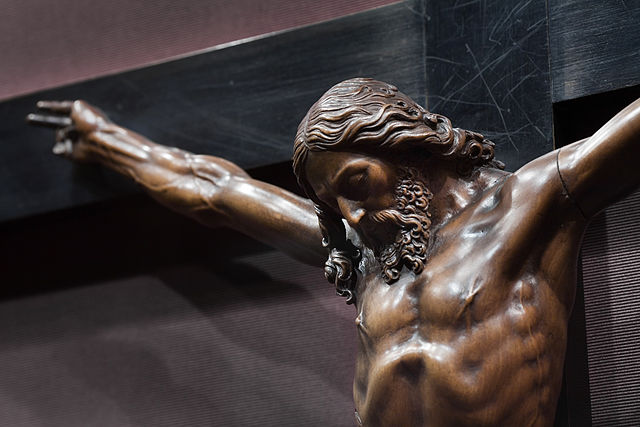
I left and knelt in the church to complete my penance. Ask for Jesus’ blessing on you and your family. That’s it? Is that even a penance? I wondered. Sounds more like a gift. That’s not nearly enough to make up for what I’ve done! I thought as I looked up at the crucifix above the altar. It’s not enough. Was the answer. You can’t make up for what you’ve done. I made up for what you’ve done. Just like this. On the Cross. This is all my gift to you. I love you this much.

Can we understand God’s love and mercy if we don’t face our sin? Can we rejoice over our salvation if we don’t realize what we’ve been saved from?

I had been wrong about Confession. It wasn’t a humiliating hoop God was making me jump through. It was a gift offered out of His love. He didn’t want me to bear the weight of my guilt any more. He wanted me to offer it to him, to let it go, to be reconciled, to live in grace. He wanted to give me the chance to be free from sin, to receive his mercy and love.

Now when I hear someone is about to make their first confession, I am so excited for them. The joy, the peace, the beauty of it. During this lenten season when I go to Confession before Holy Week, I won’t tremble in fear like I did the first time, three years ago. I will tremble instead at the weight of God’s mercy. Behold! God’s love for you.

EmailFacebookGoogle ReaderPinterestTumblrTwitterShare

The Big Ol’ Catholic Reading List

Ok, so it’s not that big and it’s definitely not in the ballpark of comprehensive (would that even be possible?). But, in response to a reader’s request for resources on Catholic teaching, Catholic motherhood, Catholic blogs, and books that influenced our decision to convert, here’s…well, something. It’s off the top of my head with a couple suggestions and notes from Daniel. I would LOVE your suggestions and recommendations for additions!

CATHOLIC TEACHING/CATHOLIC THOUGHT:

(Daniel’s note regarding recommended reading for Catholic thought that also influenced our conversion:

“Read the Church Fathers, beginning with Ignatius of Antioch. Before I was Catholic, I thought that the Protestant Reformation was necessary because of a steady decline that had taken place in the Church from its very beginning. I thought that everything would be great if we could just get back to the Early Church. But I figured we just didn’t have a record of that time. Turns out, we do. Ignatius of Antioch lived in the first century and was martyred in the beginning of the second so his writing held a lot of weight with me. When I read his letters, I was quite surprised by what I found. Over and over again, he emphasizes loyalty to the bishops; an idea that was totally foreign to me. He spoke of the Church as a single organization with a hierarchy and chain of command. He also spoke of the Eucharist with great reverence and called it the ‘medicine of immortality.’

Continuing through the centuries… St. Augustine, St. Maximus the Confessor, St. Anselm. With these guys, it wasn’t so much a particular argument they made that drew me to the church. Instead, it was the continuity that exists over the centuries in their writings. This flew in the face of my idea that there was a ‘falling away’ from the truth. Quite the opposite, their was unbroken consistency of thought and teaching that existed from the early church all the way up to the contemporary Catholic Church. Maximus emphasizes this continuity (albeit in the 7th century).”)

A good place to start is with The Epistles of St. Clement of Rome and St. Ignatius of Antioch. There’s a good Paulist Press edition. Also worth reading are: The Prayers and Meditations of St. Anselm, Confessions or the Enchiridion of Faith, Hope, and Love of St. Augustine, and Selected Writings of Maximus Confessor.

The Catechism of the Catholic Church—doesn’t get much better than this. Confession: I haven’t read the whole thing. Maybe remedying that should (obviously?) be one of my Lenten devotions.

Signs of Life by Scott Hahn—Daniel and I read this together during Lent two years ago. There are 40 chapters so it’s perfect for lenten reading.  Dr. Hahn is also a convert and this book is a beautiful introduction to Catholic sacraments, sacramentals, and practices. Hahn includes many, many Scripture references in his chapters which is always helpful to those of us coming from a Protestant background.

Orthodoxy by G.K. Chesterton—Just awesome. Everything Chesterton writes is delightfully funny and painfully true.

On Being Catholic by Thomas Howard: Written by a convert, this book explains facets of the Catholic faith and Catholic worldview and dispells minunderstandings of the Catholic faith that might arise coming from a Protestant worldview.

On Loving God by St. Bernard of Clairvaux—Following in the footsteps of St. Augustine, this medieval saint writes beautifully. I am a medievalist at heart and I just love St. Bernard. Here’s an example: “Faith certainly bids me love him all the more whom I regard as that much greater than I, for he not only gives me myself, he also gives me himself.”

Why Do Catholics Eat Fish on Friday?: The Catholic Origin to Just About Everything by Michael P. Foley—Written by one of our Baylor profs, this is a delightful read.

And if you’re up for something dense but amazing—any of the writings of St. Thomas Aquinas.

CONVERSIONS:

Return to Rome by Francis Beckwith—Dr. Beckwith’s story of his reversion to Catholicism after becoming Protestant and being President of the Evangelical Theological Society.

Crossing the Tiber by Stephen RayPart I is his conversion story from Protestantism and Parts II and III are on Baptism and the Holy Eucharist.

Confessions by St. Augustine—the ultimate conversion story.

The Seven Storey Mountain by Thomas Merton—Another good conversion story highlighting the working of God’s grace guiding us, even when we are unaware.

Apologia Pro Vita Sua by the Blessed John Henry Newman—The spiritual autobiography of a former Anglican. Confession: I haven’t read this one, but Daniel really liked it.

CATHOLIC PRAYER AND DEVOTION:

St. Benedict’s Prayer Book—We love using this for morning and evening prayer for our family.

An Introduction to the Devout Life by St. Francis de Sales—Exhortations to holiness through prayer and examination of conscience by a wonderful saint of the Church.

The Rosary: Keeping Company with Jesus and Mary by Karen Edmisten—Fantastic introduction to praying the Rosary. I’ve read it twice and it has helped me make the Rosary a frequent and familiar devotion in my spiritual life.

MOTHERHOOD:

Familiaris Consortio, Encyclical by the Blessed Pope John Paul II: This one definitely falls into the category of Catholic teaching but has much to say on motherhood and the family in modern life. I’m more than halfway through and loving it.

HAGIOGRAPHY:

Catherine of Siena by Sigrid Undset—Well-researched and beautifully written biography of St. Catherine of Siena by Sigrid Undset, another fellow convert to Catholicism.

Saint Thomas Aquinas, “The Dumb Ox” by G.K. Chesterton—Nobody writes biography as delightfully as Chesterton. A wonderful introduction to this great saint.

FICTION:

ANYTHING written by Flannery O’Connor. My favorite is The Violent Bear It Away.

(Daniel’s note: “This is hard to explain. Perhaps it was that she was a Southern author writing about the South. I guess she was able to translate her Catholicism into the language of my Southern Protestantism. I can’t really put my finger on it. Obviously, the sacraments are a huge part of her work, even when they are slightly hidden. There is a kind of radicalism in her stories that makes sense to me and I think is a core part of the Gospel message. There is a totality to it that I think is clearly shown in Catholic theology. She also helped me see that some of my objections to the Catholic Church were actually rooted in my modern, materialist perspective and not really in anything biblical.”) Warning: If you’ve never lived in the South…these works might be really hard to understand.

Brideshead Revisited by Evelyn Waugh: THE 20th Century Catholic Novel. Wickedly funny and full of heartbreaking truth, Brideshead follows the working of God’s grace in the aristocratic Flyte family through the eyes of their friend Charles Ryder. I read it every year and the characters have become beloved companions. I can’t explain why, but I think this book influenced me to become Catholic more than any other.

Kristin Lavransdatter by Sigrid Undset: I’ve written about how much I love this saga before—how often do you find good medieval historical fiction? Kristin’s spiritual journey chronicled throughout the books is complex, beautiful, and worth reading.

The Lord of the Rings by J.R.R. Tolkien (Daniel’s note: “I guess this is hard to explain, too. Maybe part of it was that I absolutely loved Tolkien and his worldview. So the fact that he was Catholic made me see Catholicism in a more positive light. There are also a lot of sacraments in his work. The Eucharist shows up all the time.”)

What are your suggestions for MUST-READ books and resources on Catholic faith?

(p.s. Don’t forget to enter my giveaway for a copy of the clothbound Penguin classic edition of Pride and Prejudice! It ends tomorrow at noon!)

This post contains Amazon affiliate links. Thank you for supporting me!

EmailFacebookGoogle ReaderPinterestTumblrTwitterShare