Category Archives: Saints

Catholicism: Empowering Women for 2000 Years (Part III: Female Saints and Doctors of the Church)

So we’ve talked about how Marian doctrine taught me to celebrate my womanhood and how the Catholic idea of vocation honors women. But I want to share with you how learning about the saints and doctors of the Church taught me to love the diversity and strength of women in the communion of saints.

In Part II I shared how before converting to Catholicism, I felt that my gifts didn’t fit in anywhere in the church. It wasn’t until I started learning about the saints that I discovered that there is a place for everyone. Just because the Church teaches that men and women have different roles, that doesn’t mean that Catholic women are rigidly boxed into a narrow “type.” There are holy women that are completely different from each other and each Christian is called to display Christ’s love in a unique and beautiful way. If each of us were a stained glass window, we would have our own unique image to display the light of Christ.

So what kind of women are honored as saints of the Church?

There are warriors. St. Joan of Arc certainly didn’t fit into a traditional female role. Born a peasant, she was not a homemaker, mother, wife, or nun. She was a fearless military leader. Yet, she is held up as a model of Christian devotion. An interesting choice for a Church criticized for wanting all it’s women barefoot and pregnant in the kitchen.

There are mothers. A striking juxtaposition to St. Joan is St. Elizabeth Anne Seton, a fellow convert, loving wife and mother, and a lover of literature that was devoted to education and service. The first native-born American to be declared a saint! There’s also St. Monica, the holy mother of St. Augustine whose faithful prayers ushered him into the faith. Or St. Gwen, my confirmation saint, who gave birth to three saints, was kidnapped by Anglo-Saxon pagans, escaped twice, and was later martyred.

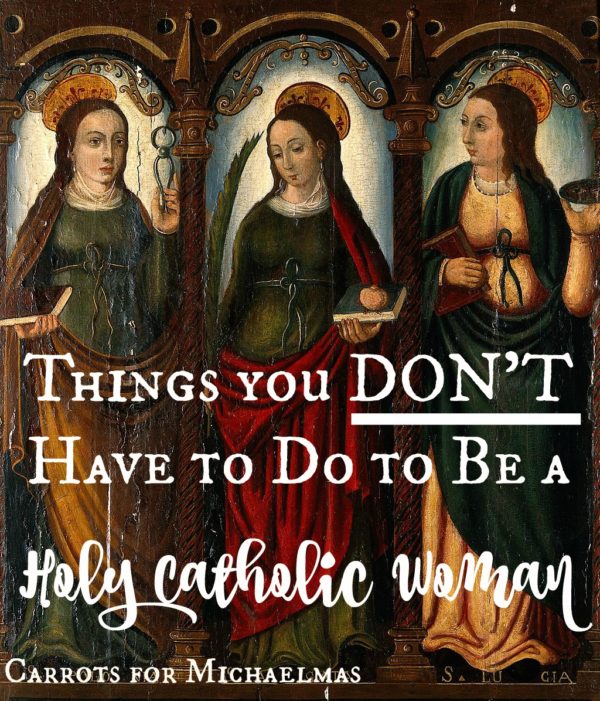
There are holy virgins. Take St. Lucy, for example, who fiercely defied being bullied into an unwanted marriage with a pagan Roman, undergoing the cruelest tortures her persecutors could imagine. She remained devoted to her Christian faith despite her torturers attempts to blind her, burn her, and send her to a brothel and was martyred for her faith.

No story is the same. No woman is the same. By holding up these amazing women for all Christians to emulate, the Church affirms that women are courageous, strong, persevering, faithful, intelligent, influential, and valuable.

Perhaps even more astonishing than the diversity of female saints, especially considering the inequality in education that women have encountered throughout history, there are four women who are named Doctors of the Church, a rare title that elevates their writings as greatly influential works that are helpful to the Church. To put this in perspective, there are only two popes who are named Doctors of the Church. I always thought that only folks like St. Thomas Aquinas, highly educated dead white guys, held that sort of honor. Not so. I think this speaks volumes to the respect the Church has for a woman’s mind. There’s certainly a higher percentage of women included here than I encountered in the texts studied in any of my Philosophy classes.

One of these amazing Doctors of the Church, St. Catherine of Siena, refused to accept the role her family had in mind for her: to marry well in medieval Italy. Instead, this holy woman devoted herself to a life of consecrated virginity. She was illiterate (until later in life when she was given the ability to read and write by supernatural means) but became the advisor of popes and political leaders. During a time of great turmoil for the Church, this strong and brave woman held great sway and blessed the Church with her holy guidance.

St. Therese of Lisieux, on the other hand, wasn’t a public figure by any stretch of the imagination and her desire was to serve God through “the little way” or the ordinary, every day tasks of one’s life. She lived a cloistered life and died very young of tuberculosis. Yet, the writings she left behind are honored next to those of popes and bishops. She is, in fact, the youngest of all the Doctors of the Church.

St. Hildegard of Bingen was a medieval abbess and a polymath, musician, poet, illuminator, philosopher, theologian, and visionary. During the era misnamed the “dark age,” St. Hildegard’s stunning intellect and writings shone with her vibrant faith. Even as a little girl, decades before my conversion, I was intrigued by St. Hildegard’s fascinating life and intelligence.

St. Teresa of Avila was a Carmelite nun, mystic,  and influential writer of the Counter Reformation era. Her great works, such as The Interior Castle, are prized for their insights on the contemplative life and mental prayer.

Warriors, mothers, martyrs, aristocrats, peasants, academics or illiterate, there is room for everyone. Getting to know the saints has given me a new perspective of a “woman’s role” in the Church. It is not narrow. It is not rigid. There is a place for everyone to be celebrated for the gifts God has given them and the unique way they can serve his Holy Church.

The end of this series, Part IV, on Church teachings about marriage, fertility, and contraception coming soon.

(image source: lenarpoetry.blogspot.com, from Sacred Heart Catholic Church, Dover, NJ)

EmailFacebookGoogle ReaderPinterestTumblrTwitterShare

A Simple Meal for St. Brigid’s Day, February 1st

 Tomorrow is St. Brigid’s Day, so I wanted to share a post I wrote for our neglected real food liturgical year blog. Included is a simple recipe for a seasonal soup to be paired with bread and honey butter. It’s quick, easy, and as St. Brigid’s Day falls on a Friday this year, vegetarian. Enjoy!

Remember to vote for Carrots in the Sheenazing Blogger Awards! It will only take a minute and would mean so much to me. Carrots is up for: Coolest Blogger, Best Looking Blog, Most Inspiring Blog, and Best Lifestyle Blog. You can place your votes here at A Knotted Life. Voting ends tonight (Thurs) at 6pm. Thanks ever so!

February 1st celebrates the Feast of St. Brigid (c. 451-525), a nun, abbess, and friend of St. Patrick’s in early Christian Ireland. St. Brigid founded the monastery of Kildare where the Book of Kildare, an illuminated Gospel manuscript was created. The art historian in me needs to follow a brief tangent to say that according to 12th century writer, Gerald of Wales, this manuscript was so wondrous that he believed the illuminators were assisted by angels. The Book of Kildare has since been lost but would perhaps have rivaled the Book of Kells in intricacy and beauty.

To celebrate this patron saint of Ireland, I made “St. Brigid’s Oaten Bread” from a recipe I found on the Catholic Cuisine blog. I used 3/4 whole wheat flour and 1/4 spelt flour and it turned out great.

It was so simple to make! We paired the bread with a simple chickpea soup inspired by a recipe in Twelve Months of Monastery Soups by Brother Victor-Antoine d’Avila-Latourrette. I made some substitutions, simplified, and added some seasonal veggies we already had.

Here’s my recipe:

2 cups dried chickpeas (soak them the night before)

1 onion, diced

olive oil

10 cups vegetable broth

chopped spinach

4 garlic cloves, minced

2 turnips, diced (you can substitute potatoes if you like, turnips were just ready in our garden)

seasonings: dried thyme, rosemary, oregano, salt, pepper and 1 bay leaf

Directions: Sauté the onion in olive oil then add the other ingredients. Bring to boil then cook for an hour.

Daniel concocted our favorite supplement to a dinner of soup and bread:honey butter. Just add some honey to some softened butter and bam! It makes a simple meal into a treat.

And we used our green dishes to celebrate this Irish saint! Pray for us, St. Brigid!

If you looking for more resources on how to celebrate St. Brigid’s Day, be sure to check out Sarah O’s recent Little Holydays post all about it!

EmailFacebookGoogle ReaderPinterestTumblrTwitterShare

The Feast of St. Thomas Aquinas: Recipe for Grilled Pork Chops Lazio Style

January 28th is the feast of St. Thomas Aquinas. This is a post Daniel wrote for our woefully neglected real food liturgical year blog a couple of years ago. This meal was amazing. Reading the writing of St. Thomas had a huge impact on our conversion, so he holds a special place in my heart. Happy Feast!

Thomas was a 13th century Dominican priest and scholar from Aquino, Italy who made gigantic contributions to theology, philosophy, and Academia. For these reasons he was made a Doctor of the Church, a recognition of his importance and the trustworthiness of all of his teachings. Even secular scholars consider him to be one of the most important Western thinkers.  It would be difficult to overstate his genius and holiness. However, towards the end of his life, Christ visited Thomas while he was celebrating Mass. As a reward for all of his work, Christ offered to give him whatever he desired. When asked what he wanted, Thomas replied, “Only you Lord. Only you.” After this, Thomas experienced an ecstasy and saw a vision. He never told anyone what he had seen but he no longer desired to write. When a friend suggested he take up his pen again and finish his books, Thomas replied, “I cannot, because all that I have written seems like straw to me.” That’s probably worth thinking about.

Since St. Thomas was from Aquino, which is in the Lazio region of Italy, I made Costarelle di Maiale alla Laziale (grilled pork chops Lazio style). We also had a bottle of Sangiovese/Chianti, wine from that area.

To make the costarelle di maiale all you need are some pork chops, good olive oil, wine, pepper, salt, and some Italian bread.

1.     Get your grill going. A wood fire is best, especially since the recipe is so simple.

2.     Slice your bread, nice and thick. Dip the chops into the oil, wine, pepper, and salt.

3.     Toss the chops on the grill and place the bread on top to soak up some of the juice.

4.     Flip the chops and place the bread directly on the grill. Be careful, you don’t want the bread to burn or the meat to dry out. Nothing is worse than dry pork. That’s probably in the Summa somewhere.

We ate this with some greens from the garden. I forget what kind. Maybe cauliflower leaves. We also drank the rest of the wine. St. Thomas Aquinas said many brilliant things. Among them was, “Sorrow can be alleviated by good sleep, a bath, and a glass of wine.”

Here’s a prayer of his:

O creator past all telling, you have appointed from the treasures of your wisdom the hierarchies of angels, disposing them in wondrous order above the bright heavens, and have so beautifully set out all parts of the universe.

You we call the true fount of wisdom and the noble origin of all things.
Be pleased to shed on the darkness of mind in which I was born,
The twofold beam of your light and warmth to dispel my ignorance and sin.

You make eloquent the tongues of children.
Then instruct my speech and touch my lips with graciousness.
Make me keen to understand, quick to learn, able to remember;
make me delicate to interpret and ready to speak.

Guide my going in and going forward, lead home my going forth.
You are true God and true man, and live for ever and ever. Amen.

EmailFacebookGoogle ReaderPinterestTumblrTwitterShare

Little HolyDays: The Feast of St. Nicholas

Welcome to our first Little HolyDays link up and Happy New Year! No, I haven’t gotten the months confused, it’s the beginning of a new liturgical year. Yesterday was the first Sunday of Advent. Let’s hope you were more organized than I and didn’t spend part of your Sunday scrambling around looking  for your Advent wreath (don’t worry! I found it!).

Anyhow, for our very first Little HolyDays link up (yay!) I wanted to share with you about what we’ll be doing to celebrate the Feast of St. Nicholas on Dec. 6th. (The Little HolyDays link up is at the bottom).

Until recently, I didn’t know anything about St. Nicholas other than the fact that Santa Claus is his strange holiday descendant of sorts. When I did get to know St. Nicholas a little bit, he turned out to be a huge surprise. This ain’t yo’ grandma’s saint! Well, I don’t know your grandma. Maybe she has a great devotion to St. Nicholas. But what I’m trying to say is, St. Nicholas is nothing like his jolly, rosy-cheeked, red-suited, cookie-snarfing counterpart who is concerned with everyone’s “niceness.” In fact, I don’t think St. Nicholas put much stock in “being nice” but he was a fighter for the truth—literally.  From examinations of this holy bishop’s relics in Bari, Italy, it’s clear that he sported a seriously broken nose. It appears to be broken multiple times and some legends even claim he grew up as a street fighter. We do know that he was kicked out of the Council of Nicea for punching the heretic Arias in the face. Arias was teaching that Christ was not fully divine and St. Nicholas just couldn’t listen to another word.

Image from cantaur.blogspot.com

Fist raised and causing a riot. Jolly Old St. Nicholas, right?!

While I’m not advocating punching heretics in the face, (and he did get in big trouble for his violent act), I can’t help but love St. Nicholas for his fiery passion for the truth. In case the face-punch tale has you convinced that St. Nicholas was a big jerk, let me tell you a couple more stories to reveal this saints courage and compassion. Upon hearing that three innocent men were going to be executed, St. Nicholas ran to the scene and demanded that the executioner put down his sword. The courage and authority of the saint halted the execution and the prisoners were freed. Or maybe the executioner heard about what happened to Arias. When St. Nicholas heard that a poor man’s three daughters had no dowry to marry and would likely be forced into prostitution, he anonymously provided them each with a generous dowry. This may be how the tradition of giving gifts to children on St. Nicholas Day got started. I love St. Nicholas’s passion and active love, even though it must have gotten him into trouble sometimes. I think his devotion to justice, truth, and charity is something that merits a big celebration.

At our house, we exchange gifts on St. Nicholas Day instead of Christmas Day. It’s traditional to fill children’s shoes with little presents and so we buy each child a new pair of shoes, fill them with little edible treats, and wrap up any other little gifties we’re giving our little ones. Presents at our house are a simple affair, but we don’t want them to be the focus of Christmas so we like enjoying them together on a different day. We do join my husband’s family on Christmas Day to exchange gifts with them, but so far I think our kids enjoy being together with their extended family as much as the gifts. The presents themselves don’t seem to take the spotlight off the meaning of the day. How do you arrange gift-giving in your Christmas traditions?

This year, as St. Nicholas Day falls on a Thursday, we’ll try to attend the 7am Mass followed by presents and we’ll end the day with a feast: Sparkling Pear Juice as a special treat for the kids (and this pregnant gal), Cranberry Chicken from this cookbook, fresh greens from our urban garden, and I’ll try to create a gluten-free version of these traditional St. Nicholas Day spice cookies.  In general, our Advent is pretty somber: lots of vegetarian meals, simple soups, and quiet evenings. St. Nicholas Day is a bright spot in the First Week of Advent.

We don’t really celebrate Santa Claus, although our kids know who he is and know that many families do Santa-related things during the month of December. And I don’t think Santa is bad or that family’s with special Santa traditions should give them up. But let’s be real, in a contest for awesomeness, I think the generous, brave, face-punching saint is the clear winner. :)

***********************************************************************

Now it’s time for you to share your traditions!

We are three Catholic bloggers who love to observe the liturgical year to deepen our families’ faith and build up the domestic church. We would love to hear about your family’s celebrations and traditions! Please join us in “redeeming the time” in this Year of Faith by sharing your posts (old or new) about feast days, liturgical seasons, etc. in this new linkup. We are starting at the beginning of the Liturgical Year: The Season of Advent!

Some topics we would be excited to read about during the Advent and Christmas seasons are (but not limited to!):

  • Sustainability and Responsible Gift Giving/Food
  • Food & Recipes
  • Simple Holiday traditions, crafts and activities
  • Reflections on the seasons
  • Charity
  • Teaching and Learning  about the Christian Year with Children

This link up will be open until Thursday evening, December 6th. There will be a new link up open on Monday, December 10th, and we will highlight some of our favorite links from the previous week in the new post, and on a Little HolyDays Pinterest board.

For the three of us, this link up is a way in which we plan on exploring and deepening our Catholic faith, but we would really love to hear from bloggers of all denominations.

We welcome you to share your own feast, festivals, and celebrations that fall within each week of December.

As moderators of this link up, we will reserve the right to remove any offensive or off-topic posts as we see fit, in order to maintain a kind and positive atmosphere.

So, here’s what you do:

1. Click the linky below to add your post to the Little HolyDays link up.

2. Add the Little HolyDays button (code below) to the bottom of your post so your readers can find the other great links!

3. Come back next week to see our favorite posts from the previous week and link up again.

We can’t wait to read your posts and get inspired by your traditions!


My Button

<a href=”http://carrotsformichaelmas.com/2012/12/03/little-holydays-the-feast-of-st-nicholas/” title=”Carrots for Michaelmas”> <img src=”http://i1145.photobucket.com/albums/o515/Mollymakesdo/DSC_0740-1.jpg” width=”200″ height=”200″ alt=”My Button” style=”border:none;” /></a>


Powered by Linky Tools

Click here to enter your link and view this Linky Tools list…

(You won’t see the links until you click through. Thanks for joining us!)


EmailFacebookGoogle ReaderPinterestTumblrTwitterShare

The Feast of St. Andrew, Nov. 30th

Tomorrow is the Feast of St. Andrew. Daniel whipped up this fabulous meal of Tahini Tilapia for our celebration of St. Andrew (a fisherman)  a couple of years ago and it’s still a staple at our house. And since November 30th is on a Friday this year, how handy that it’s fish for us Catholics, right?

The following is drawn from a post on Feast!, our woefully neglected Christian Year blog, that my husband Daniel posted in 2010. I’m more than a little embarrassed at how bad our photography was back then but…here ’tis:

Fisherman, brother of Simon Peter, friend and apostle of Christ, evangelist, and martyr. Andrew was first a disciple of John the Baptist and, according to John the Evangelist, was the first disciple called by Christ. After Christ’s death, resurrection, and ascension, St. Andrew went out to preach the Gospel. He travelled as far north as the Black Sea (which is why he is patron saint of Russia and the Ukraine) but was finally martyred in Achaea, Greece.  Ancient sources say Andrew was bound, not nailed, to a cross.  Iconography from the middle ages shows his cross to be raised in the shape of an X, hence the familiar “St. Andrew’s Cross” on the Scottish flag.

For today’s feast we made fish in remembrance of St. Andrew’s first profession. I don’t know exactly what kind of fish Andrew would have caught. But I read that tilapia are still caught in the Sea of Galilee and they’re an easy fish to find at the grocery store so we went with that. Then I found this Middle Eastern recipe for fish with tahini sauce and adjusted the proportions. Here are the ingredients for the sauce:

We also had couscous and sautéed greens from our garden. Spinach, kohlrabi, Swiss chard, and parsley.

Here’s the final product.

O glorious St. Andrew, you were the first to recognize and follow the Lamb of God. With your friend, St. John, you remained with Jesus for that first day, for your entire life, and now throughout eternity. As you led your brother, St. Peter, to Christ and many others after him, draw us also to Him. Teach us to lead others to Christ solely out of love for Him and dedication in His service. Help us to learn the lesson of the Cross and to carry our daily crosses without complaint so that they may carry us to Jesus. Amen.

Has your family ever celebrated St. Andrew’s Day? 
EmailFacebookGoogle ReaderPinterestTumblrTwitterShare

Soul Cakes! (Gluten-Free)

Making Soul Cakes during Hallowtide (All Hallows Eve, All Saints Day, and All Souls Day) has become a little tradition at our house. Now that we know that our three-year-old is severely allergic to gluten, we’re having to try some new recipes. I wanted to share this one with you just in time for All Souls tomorrow.

As a kind of early version of Trick-or-Treating, folks would go door-to-door and ask for Soul Cakes in exchange for saying prayers for the dead. I really love the way Hallowtide puts death in context. We remember our dead, we say prayers for the souls in Purgatory, we celebrate the lives of the saints, and we remember that Christ has ultimately conquered death. It’s power was broken by the power of the Cross. Especially in our culture that seeks to avoid the topic of death, I think observing Hallowtide is really important.

So, make yo’self some Soul Cakes and celebrate!  This morning at Mass we sat behind some adorable children dressed up as St. Elizabeth of Hungary and St. George. Someday I will be organized enough to make my kiddos fun saints costumes. Until then, baked goods will have to suffice.

I was inspired by this recipe. I used less sugar, tinkered with the spices, and used GF baking mix instead of all-purpose flour. They turned out delicious, although a bit crumbly (as GF stuff always does).

Gluten-Free Soul Cakes

Ingredients:

Raisins: 1/2 cup (plus some to decorate top)

Butter: (softened) 3/4 cup

Sugar: 2/3 cup

Eggs: 3 yolks

Gluten-Free Baking Mix: 1 3/4 cup

Nutmeg: 1/2 TSP

Cinnamon: 1 1/2 TSP

Cloves: 1/2 TSP

Milk: 1/2 cup

Preheat oven to 375. Grease muffin tin (I used butter). Cream the softened butter with the sugar. Add egg yolks and mix. Combine with GF baking mix, nutmeg, cinnamon, cloves, milk, and raisins. Fill muffin tins 2/3 of the way up with mixture. Add raisins on top in the shape of a cross. Bake for 15 minutes (longer if your muffin tin is for larger muffins, mine is for smallish ones). Check to see if your Soul Cakes are done by seeing if a knife comes out clean. And carefully remove them from muffin tin (I used a spoon to separate the edges from the muffin tin and only one of them ended up impossibly crumbly, so success!).

It’s such an easy recipe that my 3-year-old was able to help with everything except separating the egg yolks from the whites. And he LOVED adding the cross-shaped raisins on top. In fact, at this very minute he is in bed singing to himself: “Soul a’soul, a’soul cake. Please good missus a soul cake…”

EmailFacebookGoogle ReaderPinterestTumblrTwitterShare

Michaelmas Traditions: Prayers, Food, and Flowers

Michaelmas is quickly approaching: September 29th (next Saturday)! It will come as no surprise to you that I love St. Michael’s Day. It was the first feast we celebrated when we started observing the Christian Year in 2009, the Fall before our conversion to the Catholic faith.

What is Michaelmas?

Michaelmas (pronounced Mickel-mas) is a feast day celebrating the Archangels. It follows the fall Ember Days  during which Christians traditionally thanked God for his creation and the bounty of the earth and fasted penitentially. Michaelmas was a Holy Day of Obligation until the 18th century and honors St. Michael, St. Gabriel, and St. Raphael. My linguist husband particularly likes the name Michael which means in Hebrew “Who Is Like God?” and is the battle cry of the angels. St. Michael fought against Lucifer and the fallen angels and defended the friends of God. You probably remember that St. Gabriel announced the coming of Jesus to the Virgin Mary and also the coming of John the Baptist to Zachariah. St. Raphael is found in the book of Tobit.

Michaelmas Menus:

For a seasonal table for Michaelmas, think of autumnal foods. Usually our Michaelmas feast is full of beta-carotene.

Carrots are very traditional. According to a Scottish custom, women would harvest wild carrots on Michaelmas by digging triangular holes with a three-pronged mattock. Apparently the holes represent St. Michael’s shield and the mattock represents his trident.

I love this Whiskey-Glazed Carrots recipe by The Pioneer Woman. These are seriously amazing. Whiskey? Butter? Brown Sugar? Can you go wrong?

St. Michael’s Bannock on the left!

Another traditional food is St. Michael’s Bannock, a simple, sweet bread. We’ve used the recipe from Meredith Gould’s The Catholic Home. It’s super easy and turns out well.

Goose is also very traditional but we’ve discovered that it’s almost impossible to find an organic goose that’s remotely in our price range. So, we’ve cooked turkeys or chickens for the occasion. Last year we roasted sweet potatoes and onions with the chicken which turned out so yummy.

Blackberries: There’s a legend concerning Lucifer falling into a blackberry bush after being expelled from heaven by St. Michael and spitting on the blackberries to make them bitter so that they cannot be picked after Michaelmas.

On Michaelmas Day the devil puts his foot on the blackberries.

-Irish Proverb

We’ve had blackberry buckle and blackberry cobbler but since they’re not in season right now in Florida, we try to just get organic frozen berries.

A super easy and yummy blackberry cobbler recipe is The Pioneer Woman’s.

A Michaelmas Prayer:

Saint Michael the Archangel,

defend us in battle;

be our protection against the wickedness and snares of the devil.

May God rebuke him, we humbly pray:

and do thou, O Prince of the heavenly host,

by the power of God,

thrust into hell Satan and all the evil spirits

who prowl about the world seeking the ruin of souls.

Amen.

Michaelmas Daisies:

The aster flower, also known as the Michaelmas Daisy is in season in North America at the end of September. We meant to grow some from seed but…never got around to it. Last year my two sweet boys picked beautiful Daisies they found and Bachelor’s Buttons and Marigolds from our garden to decorate our Michaelmas table because I was almost 9 months pregnant:

What a pretty sight to wake up to on Michaelmas morning!

The Michaelmas daisies, among dede weeds,

Bloom for St Michael’s valorous deeds.

And seems the last of flowers that stood,

Till the feast of St. Simon and St. Jude.”

How does your family celebrate the Feast of St. Michael and the Archangels?

EmailFacebookGoogle ReaderPinterestTumblrTwitterShare

I’ve Got Greens and the Terrible Threes Growing in My Garden

Here’s what’s been going on outdoors in our neck of the woods:

Lots of park dates and outside play for this little guy. Baby girl is content to just sleep in the baby wrap with Mama while Little Bear gets his wiggles out. Although the terrible threes subsided a little bit in the past couple of weeks (perhaps due to extra time with Daddy during our trip), they were back in full force yesterday. You know the mother you see at the park that is carrying an infant and attempting to wrangle a misbehaving toddler? A toddler that is screaming, I WON’T! I DON’T WANT TO! when she asks him to throw away his trash, then succumbs to sobs when a kind park user cleans it up in his stead and he screams, “BUT I WANTED TO THROW IT AWAY! GET IT OUT OF THE TRASH SO I CAN DO IT! *SOB*”? That mother? The one that makes you say to your friend, “she has HER hands full. A little discipline? I would be mortified if MY child ever behaved like that!” Well, I am that mother. Nice to meet you. I now sympathize with all mothers of children who misbehave in public.

After a full-fledged meltdown in the car and an early nap, Benjamin surprised me by saying, “Hey, Mama. You know what? I love you.” He doesn’t usually say that out of the blue. Made the difficult morning worth it. Thankfully, he’s been good as gold today.

Our vegetable garden is exploding with wonderful things!

Bright Light Swiss Chard has to be one of the prettiest things ever!

Tomato flowers already! I can’t wait to eat tomatoes with every meal. Daniel has grown so many seedlings of different varieties.

We’ve been eating all the lettuce we can handle. Picking lettuce for salad 10 minutes before dinner time is so fun.

Cabbages are looking lovely!

My farmer.

This was our St. Patrick’s Day feast. Guinness Beef Stew made by Daniel, Spring Salads from the garden with Strawberries, and amazing Sweet Potato Fries by our friend Kaitlin.

What are you growing in your garden these days?

EmailFacebookGoogle ReaderPinterestTumblrTwitterShare

The Feast of St. Patrick

I hope you all have a wonderful St. Patrick’s Day today! It is spring in North Florida and the outdoors are green in honor of one of my favorite saints. The dogwoods, azaleas, and wisteria are in bloom and the scent of flowers is downright intoxicating.

And here’s a little something from the archives about St. Patrick, why I love him so much, and a St. Patrick’s Feast we made with links to a couple of recipes for Irish Soda Bread and Nigella’s Guinness Chocolate Cake. Mmmmmm.

From St. Patrick’s Breastplate (an ancient prayer attributed to him)

Christ be with me, Christ within me,

Christ in my headway, Christ in my wake,

Christ alow and Christ aloft,

Christ at my right hand, Christ on my left,

Christ with me waking, waking and sleeping.


Christ in every heart thinks of me,

Christ in every tongue speaks to me,

Christ in every eye beholding,

Christ in every listening ear.

What’re your St. Patrick’s Day plans? We’re getting together with some friends to grill out and celebrate!

EmailFacebookGoogle ReaderPinterestTumblrTwitterShare

The Big Ol’ Catholic Reading List

Ok, so it’s not that big and it’s definitely not in the ballpark of comprehensive (would that even be possible?). But, in response to a reader’s request for resources on Catholic teaching, Catholic motherhood, Catholic blogs, and books that influenced our decision to convert, here’s…well, something. It’s off the top of my head with a couple suggestions and notes from Daniel. I would LOVE your suggestions and recommendations for additions!

CATHOLIC TEACHING/CATHOLIC THOUGHT:

(Daniel’s note regarding recommended reading for Catholic thought that also influenced our conversion:

“Read the Church Fathers, beginning with Ignatius of Antioch. Before I was Catholic, I thought that the Protestant Reformation was necessary because of a steady decline that had taken place in the Church from its very beginning. I thought that everything would be great if we could just get back to the Early Church. But I figured we just didn’t have a record of that time. Turns out, we do. Ignatius of Antioch lived in the first century and was martyred in the beginning of the second so his writing held a lot of weight with me. When I read his letters, I was quite surprised by what I found. Over and over again, he emphasizes loyalty to the bishops; an idea that was totally foreign to me. He spoke of the Church as a single organization with a hierarchy and chain of command. He also spoke of the Eucharist with great reverence and called it the ‘medicine of immortality.’

Continuing through the centuries… St. Augustine, St. Maximus the Confessor, St. Anselm. With these guys, it wasn’t so much a particular argument they made that drew me to the church. Instead, it was the continuity that exists over the centuries in their writings. This flew in the face of my idea that there was a ‘falling away’ from the truth. Quite the opposite, their was unbroken consistency of thought and teaching that existed from the early church all the way up to the contemporary Catholic Church. Maximus emphasizes this continuity (albeit in the 7th century).”)

A good place to start is with The Epistles of St. Clement of Rome and St. Ignatius of Antioch. There’s a good Paulist Press edition. Also worth reading are: The Prayers and Meditations of St. Anselm, Confessions or the Enchiridion of Faith, Hope, and Love of St. Augustine, and Selected Writings of Maximus Confessor.

The Catechism of the Catholic Church—doesn’t get much better than this. Confession: I haven’t read the whole thing. Maybe remedying that should (obviously?) be one of my Lenten devotions.

Signs of Life by Scott Hahn—Daniel and I read this together during Lent two years ago. There are 40 chapters so it’s perfect for lenten reading.  Dr. Hahn is also a convert and this book is a beautiful introduction to Catholic sacraments, sacramentals, and practices. Hahn includes many, many Scripture references in his chapters which is always helpful to those of us coming from a Protestant background.

Orthodoxy by G.K. Chesterton—Just awesome. Everything Chesterton writes is delightfully funny and painfully true.

On Being Catholic by Thomas Howard: Written by a convert, this book explains facets of the Catholic faith and Catholic worldview and dispells minunderstandings of the Catholic faith that might arise coming from a Protestant worldview.

On Loving God by St. Bernard of Clairvaux—Following in the footsteps of St. Augustine, this medieval saint writes beautifully. I am a medievalist at heart and I just love St. Bernard. Here’s an example: “Faith certainly bids me love him all the more whom I regard as that much greater than I, for he not only gives me myself, he also gives me himself.”

Why Do Catholics Eat Fish on Friday?: The Catholic Origin to Just About Everything by Michael P. Foley—Written by one of our Baylor profs, this is a delightful read.

And if you’re up for something dense but amazing—any of the writings of St. Thomas Aquinas.

CONVERSIONS:

Return to Rome by Francis Beckwith—Dr. Beckwith’s story of his reversion to Catholicism after becoming Protestant and being President of the Evangelical Theological Society.

Crossing the Tiber by Stephen RayPart I is his conversion story from Protestantism and Parts II and III are on Baptism and the Holy Eucharist.

Confessions by St. Augustine—the ultimate conversion story.

The Seven Storey Mountain by Thomas Merton—Another good conversion story highlighting the working of God’s grace guiding us, even when we are unaware.

Apologia Pro Vita Sua by the Blessed John Henry Newman—The spiritual autobiography of a former Anglican. Confession: I haven’t read this one, but Daniel really liked it.

CATHOLIC PRAYER AND DEVOTION:

St. Benedict’s Prayer Book—We love using this for morning and evening prayer for our family.

An Introduction to the Devout Life by St. Francis de Sales—Exhortations to holiness through prayer and examination of conscience by a wonderful saint of the Church.

The Rosary: Keeping Company with Jesus and Mary by Karen Edmisten—Fantastic introduction to praying the Rosary. I’ve read it twice and it has helped me make the Rosary a frequent and familiar devotion in my spiritual life.

MOTHERHOOD:

Familiaris Consortio, Encyclical by the Blessed Pope John Paul II: This one definitely falls into the category of Catholic teaching but has much to say on motherhood and the family in modern life. I’m more than halfway through and loving it.

HAGIOGRAPHY:

Catherine of Siena by Sigrid Undset—Well-researched and beautifully written biography of St. Catherine of Siena by Sigrid Undset, another fellow convert to Catholicism.

Saint Thomas Aquinas, “The Dumb Ox” by G.K. Chesterton—Nobody writes biography as delightfully as Chesterton. A wonderful introduction to this great saint.

FICTION:

ANYTHING written by Flannery O’Connor. My favorite is The Violent Bear It Away.

(Daniel’s note: “This is hard to explain. Perhaps it was that she was a Southern author writing about the South. I guess she was able to translate her Catholicism into the language of my Southern Protestantism. I can’t really put my finger on it. Obviously, the sacraments are a huge part of her work, even when they are slightly hidden. There is a kind of radicalism in her stories that makes sense to me and I think is a core part of the Gospel message. There is a totality to it that I think is clearly shown in Catholic theology. She also helped me see that some of my objections to the Catholic Church were actually rooted in my modern, materialist perspective and not really in anything biblical.”) Warning: If you’ve never lived in the South…these works might be really hard to understand.

Brideshead Revisited by Evelyn Waugh: THE 20th Century Catholic Novel. Wickedly funny and full of heartbreaking truth, Brideshead follows the working of God’s grace in the aristocratic Flyte family through the eyes of their friend Charles Ryder. I read it every year and the characters have become beloved companions. I can’t explain why, but I think this book influenced me to become Catholic more than any other.

Kristin Lavransdatter by Sigrid Undset: I’ve written about how much I love this saga before—how often do you find good medieval historical fiction? Kristin’s spiritual journey chronicled throughout the books is complex, beautiful, and worth reading.

The Lord of the Rings by J.R.R. Tolkien (Daniel’s note: “I guess this is hard to explain, too. Maybe part of it was that I absolutely loved Tolkien and his worldview. So the fact that he was Catholic made me see Catholicism in a more positive light. There are also a lot of sacraments in his work. The Eucharist shows up all the time.”)

What are your suggestions for MUST-READ books and resources on Catholic faith?

(p.s. Don’t forget to enter my giveaway for a copy of the clothbound Penguin classic edition of Pride and Prejudice! It ends tomorrow at noon!)

This post contains Amazon affiliate links. Thank you for supporting me!

EmailFacebookGoogle ReaderPinterestTumblrTwitterShare