Category Archives: catholicism

Catholicism: Empowering Women for 2000 Years (Part III: Female Saints and Doctors of the Church)

So we’ve talked about how Marian doctrine taught me to celebrate my womanhood and how the Catholic idea of vocation honors women. But I want to share with you how learning about the saints and doctors of the Church taught me to love the diversity and strength of women in the communion of saints.

In Part II I shared how before converting to Catholicism, I felt that my gifts didn’t fit in anywhere in the church. It wasn’t until I started learning about the saints that I discovered that there is a place for everyone. Just because the Church teaches that men and women have different roles, that doesn’t mean that Catholic women are rigidly boxed into a narrow “type.” There are holy women that are completely different from each other and each Christian is called to display Christ’s love in a unique and beautiful way. If each of us were a stained glass window, we would have our own unique image to display the light of Christ.

So what kind of women are honored as saints of the Church?

There are warriors. St. Joan of Arc certainly didn’t fit into a traditional female role. Born a peasant, she was not a homemaker, mother, wife, or nun. She was a fearless military leader. Yet, she is held up as a model of Christian devotion. An interesting choice for a Church criticized for wanting all it’s women barefoot and pregnant in the kitchen.

There are mothers. A striking juxtaposition to St. Joan is St. Elizabeth Anne Seton, a fellow convert, loving wife and mother, and a lover of literature that was devoted to education and service. The first native-born American to be declared a saint! There’s also St. Monica, the holy mother of St. Augustine whose faithful prayers ushered him into the faith. Or St. Gwen, my confirmation saint, who gave birth to three saints, was kidnapped by Anglo-Saxon pagans, escaped twice, and was later martyred.

There are holy virgins. Take St. Lucy, for example, who fiercely defied being bullied into an unwanted marriage with a pagan Roman, undergoing the cruelest tortures her persecutors could imagine. She remained devoted to her Christian faith despite her torturers attempts to blind her, burn her, and send her to a brothel and was martyred for her faith.

No story is the same. No woman is the same. By holding up these amazing women for all Christians to emulate, the Church affirms that women are courageous, strong, persevering, faithful, intelligent, influential, and valuable.

Perhaps even more astonishing than the diversity of female saints, especially considering the inequality in education that women have encountered throughout history, there are four women who are named Doctors of the Church, a rare title that elevates their writings as greatly influential works that are helpful to the Church. To put this in perspective, there are only two popes who are named Doctors of the Church. I always thought that only folks like St. Thomas Aquinas, highly educated dead white guys, held that sort of honor. Not so. I think this speaks volumes to the respect the Church has for a woman’s mind. There’s certainly a higher percentage of women included here than I encountered in the texts studied in any of my Philosophy classes.

One of these amazing Doctors of the Church, St. Catherine of Siena, refused to accept the role her family had in mind for her: to marry well in medieval Italy. Instead, this holy woman devoted herself to a life of consecrated virginity. She was illiterate (until later in life when she was given the ability to read and write by supernatural means) but became the advisor of popes and political leaders. During a time of great turmoil for the Church, this strong and brave woman held great sway and blessed the Church with her holy guidance.

St. Therese of Lisieux, on the other hand, wasn’t a public figure by any stretch of the imagination and her desire was to serve God through “the little way” or the ordinary, every day tasks of one’s life. She lived a cloistered life and died very young of tuberculosis. Yet, the writings she left behind are honored next to those of popes and bishops. She is, in fact, the youngest of all the Doctors of the Church.

St. Hildegard of Bingen was a medieval abbess and a polymath, musician, poet, illuminator, philosopher, theologian, and visionary. During the era misnamed the “dark age,” St. Hildegard’s stunning intellect and writings shone with her vibrant faith. Even as a little girl, decades before my conversion, I was intrigued by St. Hildegard’s fascinating life and intelligence.

St. Teresa of Avila was a Carmelite nun, mystic,  and influential writer of the Counter Reformation era. Her great works, such as The Interior Castle, are prized for their insights on the contemplative life and mental prayer.

Warriors, mothers, martyrs, aristocrats, peasants, academics or illiterate, there is room for everyone. Getting to know the saints has given me a new perspective of a “woman’s role” in the Church. It is not narrow. It is not rigid. There is a place for everyone to be celebrated for the gifts God has given them and the unique way they can serve his Holy Church.

The end of this series, Part IV, on Church teachings about marriage, fertility, and contraception coming soon.

(image source: lenarpoetry.blogspot.com, from Sacred Heart Catholic Church, Dover, NJ)

EmailFacebookGoogle ReaderPinterestTumblrTwitterShare

Holy Time: Lent and Cleaning Up My Whiny Soul

(Please join us in the Little HolyDays Lenten Link-Up by sharing your posts about this liturgical season. Linky below!)

I CAN’T do it! It’s TOO HARD!” whined my then 3-year-old son as he sat in the middle of his messy room and cried at the idea of having to clean up the toys, books, and stuffed animals scattered everywhere.

Maybe I’m asking too much, I thought. He’s clearly overwhelmed. Maybe he doesn’t know where to start. “Why don’t you just put the books on your shelf to begin and then we can figure out what to do next.”

Nooooo!” he cried. “There’s TOO MANY BOOKS. I CAN’T clean them ALL up!”

OK,” I sighed. “How about this. Start with this Dr. Seuss book. Just grab it and set it on your bookshelf.”

“This is TOO HARD!” he complained. “You do it!”

Are you serious? I thought. This is his mess. I told him exactly what to do. I’m in here helping him. All I’m asking is for him to make an attempt at doing his part. This is ridiculous! I groaned.

Fast forward a couple of days. I’m praying during my holy hour in the chapel of perpetual adoration at our parish. It’s Lent. I’m tired and discouraged. It’s just not going well. No progress is being made in cleaning up my messy soul. “Lord, I just can’t do it. It’s too hard! I’ve got all this sin all over the place and I can’t even begin to clean it up.”

Just start with one thing. Work on one small thing. Don’t be overwhelmed.

Ok, fine. But how do I even do it? How do I even start working on one thing?

Prayer, Fasting, and Almsgiving, child. Ask me to help you, embrace spiritual discipline, sacrifice and give.

“That’s too much! I can’t do all that!”

Well, why don’t you just start with prayer?

When would I have time for that?!”

Wake up 10 minutes before your babies. Ask me to help you with the one thing you want to focus on this Lent.

Give up 10 minutes of sleep?! Are you kidding me? Don’t you know how tired I am? I’m never going to be able to clean this up! And you won’t even help me! Waaaaaaaaaaa!

Then I remembered my little boy’s face, tears streaming down in frustration, his little fists clenched instead of making even the smallest attempt to begin the task before him. Look familiar? I closed my eyes and chuckled at myself. That’s me, right there. Refusing to make the smallest gesture toward changing. Because it’s not any fun to clean up your soul. It’s easier to say, “I can’t” and just keep sitting in the muck. You’ve told me exactly what I need to do to begin. You’re right here helping me. And here I am shaking my tiny fists in protest.

How often do I respond to God’s grace with absurd defiance? How often do I respond to God’s plan like my preschooler does to disagreeable instructions, “But, I don’t WANT to.” As if that’s a logical argument that gets me off the hook.

A daily struggle is our twice-a-day application of coconut oil to help our son’s horrible eczema. “I hate this!” he screams and writhes. “It doesn’t feel good! Don’t EVER do coconut oil again!” How often do I push away God’s grace because I’d rather carry on with a broken, raw soul, scratching at it til it bleeds instead of participating in his plan to heal it. “I can handle this just how it is! I don’t mind having a diseased soul! Just don’t ask me to get cleaned up, healed, and whole because I REALLY hate that.”

But just as I love my son too much to let him scratch his skin raw, no matter how much kicking and screaming applying a remedy takes, God loves us too much to let us be content to remain sick in our sin. This Lent we can sit and whine about how hard it is to make any progress on this path to holiness, or we can recognize our messy sin, ask for God’s grace, and start cleaning up. Let’s jump in with both feet and Our Lord right beside us. And pray for my whiny soul. Because I’m going to need all the help I can get.

—————————————————————————————————

We are three Catholic bloggers who love to observe the liturgical year to deepen our families’ faith and build up the domestic church. We would love to hear about your family’s traditions during this season of Lent! Please join us in “redeeming the time” in this Year of Faith by sharing your posts.

Some topics we would be excited to read about during the Lenten season are (but not limited to!):

  • Observing Lent through Food: Simple or Vegetarian Lenten Meals/Recipes and Traditions
  • Lenten traditions, crafts and activities
  • Reflections on the liturgical seasons
  • Prayer, Fasting, and Almsgiving
  • Teaching and Learning about the Christian Year with Children
  • St. Valentine’s Day
  • Mardi Gras (Fat Tuesday/Shrove Tuesday)

Please be sure to visit the other wonderful hosts, Molly Makes Do (she’s hosting a great giveaway today!) and the amazing mother/daughter duo Dualing Moms, to see what they have to say about the beginning of their lenten season!

This link up will be up until midnight on February 15th.

We will highlight some of our favorite links on our blogs, FB, Twitter, and on a Little HolyDays Pinterestboard.
This link up is a way in which we plan on exploring and deepening our Catholic faith, but we would really love to hear from bloggers of all denominations.

We welcome you to share your own fasts, feasts, and celebrations that fall within this season.

As moderators of this link up, we will reserve the right to remove any offensive or off-topic posts as we see fit, in order to maintain a kind and positive atmosphere.

So, here’s what you do:

1. Click the linky below to add your post to the Little HolyDays link up.

2. Link your post to one of the Little HolyDays hosts (text link or use the Little HolyDays image at the top) so your readers can find the other great links! 

We can’t wait to read your posts and get inspired by your traditions!


EmailFacebookGoogle ReaderPinterestTumblrTwitterShare

Preparing for Lent

Lent is almost upon us! It’s very early this year beginning a week from today, Ash Wednesday. This season of the liturgical year is represented by the color purple: the color of the bruised heart. This is the uncomfortable time preceding Easter when we remove distractions, focus on spiritual formation, and take an honest look at ourselves in order that we might prepare our hearts.

Here’s a few Lenten traditions we’re planning to incorporate into our lives during this season:

  • Cover our crucifixes with purple fabric. I let our preschooler find all the crucifixes and crosses in the house and help me do this on Ash Wednesday.

  • Display our “Crown of Thorns” grapevine wreath on our table.
  • Attend daily Mass more often. Hopefully we can do the 7am as a family because wrangling both kids in Mass while Daniel is at work is a Herculean effort for this pregnant gal.
  • Commit to a daily Rosary. I’ve improved my previously abysmal record of praying a daily Rosary since I made it one of my goals for 2013, but making a firm commitment would be a good Lenten discipline. Also, I’d like to begin praying a decade each evening as a family devotion.
  • Learn a new prayer. We learned the St. Andrew prayer during Advent (in fact, I think Benjamin knew it better than Daniel or I by Christmas Day) and I’ve been trying to decide which one we should tackle next as a family. The Memorare?
  • Read selections from Bread and Wine: Readings for Easter and Lent. Like Watch for the Light (the Advent version), I’m expecting this one to have some amazing selections and so ho hum ones that I can skip over. In past years, I’ve really enjoyed reading Signs of Life by Scott Hahn since it has 40 chapters (handy for the 40 days of Lent, right?) and it’s amazing. You can also peruse my Big Ol’ Catholic Reading List for ideas for other devotional texts.
  • Commit to a Friday evening Mass to attend with Daniel as part of our weekly “date night.”
  • Look for ways to serve. Making meals for elderly parishioners and helping the kids make encouraging cards for friends and family came to mind. How does your family tackle this element of the lenten season?
  • Go to Confession. This deserves it’s own post, coming soon.
  • Go to adoration with the kids. Daniel and I each have a holy hour but we haven’t done a good job of introducing the kids to adoration and there’s really no excuse since our parish has a chapel of perpetual adoration!
  • Stations of the Cross
  • Abstaining from meat on Fridays 

Usually I choose a certain favorite food to give up as part of my lenten discipline, but since I have been so unbelievably ill this pregnancy, I don’t think it’s a great idea to commit to giving up food items (except for meat on Fridays). I am interested in doing some unplugging from technology but I want to keep maintaining this space, so I’m not sure what that would look like. Any ideas?

Other Lenten Resources: (I’ll be spending some time re-reading these posts in the next week)

Karen Edmisten

In the Heart of My Home: Elizabeth Foss 

Lent is long, folks. Don’t forget to make time for a little of this on Mardi Gras:

How we’re going to manage a gluten-free King Cake for our allergic little Benjamin is a bit beyond me…any suggestions?

P.S. Get excited about a new round of Little Holydays starting this Monday! I hope you’ll be linking up with us!

EmailFacebookGoogle ReaderPinterestTumblrTwitterShare

Catholicism: Empowering Women for 2000 Years (Part II: But Women Can’t Be Priests!)

Last week I shared how understanding the Marian doctrine of the Catholic Church empowered me to celebrate my femininity. If you missed Part I: The Blessed Virgin Mary, go back to start there.

But Haley!” you might be thinking. “Empowered? Really? Women can’t be equal to men in the Church because they can’t be priests!” We’ve all heard about this issue in the media lately ad nauseum. Certainly, Marian doctrine can give us another perspective.  Pope John Paul II wrote in Ordinatio Sacerdotalis,

“[T]he fact that the Blessed Virgin Mary, Mother of God and Mother of the Church, received neither the mission proper to the Apostles nor the ministerial priesthood clearly shows that the non-admission of women to priestly ordination cannot mean that women are of lesser dignity, nor can it be construed as discrimination against them. Rather, it is to be seen as the faithful observance of a plan to be ascribed to the wisdom of the Lord of the universe.”

If Our Lady, first among Christians and saints, the Queen of Heaven, wasn’t included in the priesthood, it doesn’t bother me at all that I can’t become a priest, either.

But furthermore, perceiving the non-admission of women to the priesthood as a degradation misses the richness of Catholic teaching on the idea of vocation. There are four vocations: Priesthood, Religious Life (monks and nuns), Marriage, and Single Life. Lumen Gentium states that all Christians are called “to the fullness of the Christian life and to the perfection of charity.” All vocations are paths to this end and all are equal and necessary to the Church. A priest is not holier than a married or single woman because of his status as a priest. A celibate priest doesn’t get “extra credit” while God shakes his head disapprovingly at the carnal existence of a married couple. Marriage is not base. It is just as holy and sacred as a priestly vocation. The same is true of the vocation of a woman who chooses single life or religious life.

But there is the undeniable truth that the Church sees men and women as different from each other and therefore fulfilling different roles. The reasoning behind having a male priesthood is partially because Christ our Lord and High Priest was a man and a priest stands in persona Christi, he represents Christ in a special way. Furthermore, there’s the inescapable fact that when Our Lord Jesus chose his apostles, he chose twelve men. This is the model he gives to his Church for ordination.

It’s notable that although Our Lord had many faithful female followers, like Our Lady, they were not included as one of the twelve disciples. Among these devoted women are St. Mary Magdalene, the first person to see Our Lord after the Resurrection and the women at the tomb who are first told of the Resurrection on Easter morning. These women show a deep love for Christ and faith in Him that seems to surpass that of the twelve disciples who respond to the news that Jesus is risen with shock and skepticism. So certainly, the exclusion of women from the priesthood has nothing to do with a woman’s capacity for holiness. It’s not that the Church doesn’t respect women and wants to be a grumpy ol’ stick in the mud instead of progressively getting with the times. The Church doesn’t have the authority to ordain women. Christ revealed his plan for the priesthood by example and the Church trusts in his plan.

I don’t feel oppressed because the Church says I am different from a man and fulfill a different role. I am different. I can no more be a priest than my priest could be a mother. Saying women are no different from men is truly insulting. I love my womanhood as it is honored and celebrated by the Church. I love that the Salvation of the world was born of a woman. I love that my unique biology makes it possible for me to participate in the creation of life in a way that no man has ever experienced. I am different and I want that to be celebrated, not ignored.

By affirming that women cannot take on the role of priest, the Church does not mean that women are second-class, less intelligent, less holy, less capable, etc. As I will discuss in more detail in Part III of this series (The Saints), women are not relegated to home and hearth. There are so many different paths women may choose for their lives that are lauded by the Church! Are there Christian sects in which a woman’s role is rigidly narrow, even to the point of keeping some women from using their God-given talents for his glory? Unfortunately, yes. But this is not the case in the Catholic Church.

I grew up in a Protestant church in which there were no women clergy; however, in addition to women being excluded from being in pulpit, a woman was not even allowed to teach a bible study that included men. Regardless of her skill as a teacher or theologian, “Women don’t have a teaching role in the church like men do,” I was told. Does it matter that the woman who wants to teach a study on one of the Gospels is the only scholar of biblical languages in the congregation? Nope, no woman can teach a man on matters of faith. So where does that leave women who aren’t great at making lemon bars for the church bake sale, but are skilled differently? The truth is that some of us feel painfully out of place. (Nothing against lemon bars. Although, I prefer a good chocolate chip cookie if anybody’s asking.)

I don’t share this experience to be overly critical of loving and faithful Christian brothers and sisters, and I want to make it clear that this exclusion of women from any teaching role is NOT the case in every Protestant congregation by any means. Other Protestant churches I attended differed widely on this matter and some even had female clergy. But I give this example to distinguish between affirming that women cannot be priests and boxing women into such a narrow role that some are left wondering, “Where is the place for me?” I am grateful to have found a place in the Catholic Church that celebrates and honors the various and valuable gifts of women and their contributions to the Church.

(Part III, coming soon)

Edit: please see the helpful comments below that clarify the vocations. Single life cannot be chosen as a secular vocation (outside of religious vocations) without choosing a life of consecrated virginity.

image source: worldvisitguide.com

EmailFacebookGoogle ReaderPinterestTumblrTwitterShare

Catholicism: Empowering Women for 2000 Years (Part I: The Blessed Virgin Mary)

This is a series that I’ve been thinking about for months, but have been hesitant to dive into. Women and Catholicism is a hot button issue in so many circles. Story after story comes up on my news feed about how the Church oppresses women, discourages women’s rights, and promotes inequality between the sexes. According to media portrayals, the Church is stuck in the dark ages. “If only this hierarchy of men could get with the times!” is the common outcry. And yet, to me, it all sounds so very strange because since embracing Catholic teaching, I have learned to celebrate my womanhood for the first time in my life, instead of treating it as a somewhat embarrassing obstacle to be overcome.  I think this has a lot to do with Catholic teaching on the Blessed Virgin Mary, vocations, the communion of saints, and fertility. So here’s Part I of this little series, starting with Our Lady.

Part I: The Blessed Virgin Mary (Because the Best Christian Ever is a Woman)

It is startling to me that Catholics are perceived as having a negative view of women when Our Lady is so highly honored. In the Catholic faith, The Blessed Virgin Mary is the most exalted of all Christians, she is the first Christian. Worship is reserved for the Holy Trinity alone. But Catholics honor and venerate Our Lady above all other saints.

Oftentimes, it seems that our culture celebrates women who “rise above” their female state. “Look what she accomplished even though she was a woman!” we’ll say, as if being a woman is a handicap or disability to be overcome. We don’t often praise women for being uniquely feminine, perhaps because we don’t hold femininity in high regard.

We don’t honor Our Lady because she overcame her unfortunate plight to be born a woman, but because she did what no man could ever do. Her humility, grace, maternal love, faithfulness, tenderness, strength, steadfastness, and sacrifice contribute to her glory. I’m reminded of Eowyn in Tolkien’s Lord of the Rings. She doesn’t save the day in spite of being a woman, she conquers because she is a woman: “But no living man am I! You look upon a woman.” It is the second Eve that has the power to crush the serpent under her heel, not in spite of her womanhood, but because of it.

Catholics don’t hold up Mary as the model for Christian women, we hold her up as the model for Christians. Women and men are asked to look at Mary and follow in her footsteps. Not only are men called to honor all women out of respect for Our Lady, but they are called to imitate her example themselves.

There is simply nothing comparable in Protestant life. I truly think that the Protestant avoidance of Mary as well as suppression of Marian doctrine significantly contribute to the experience I, and many women, encounter in the Protestant church. We feel like second-class citizens. When you grow up hearing of Eve’s fall and never understand that Mary is the New Eve who rights the wrongs, opens the gate, and carries our Hope, it’s easy to feel that being a woman is cursed and not blessed.

Doctrines such as the teaching that Mary is the Theotokos, or God-bearer, contribute to a celebration and exaltation of womanhood. Growing up Protestant, I was often told that Mary was the mother of Jesus, not the mother of God. This is a form of adoptionism (the heresy teaching that there was a merely human Jesus that was later adopted as God’s son) and not Orthodox Christian teaching which is that at his conception, Christ was fully God and fully man. By emphasizing that Our Lady is the Mother of God, the Church not only maintains a high Christology (highlighting that Christ was always divine), but also makes the shocking assertion that God himself chose to dwell in a woman’s body as his abode for nine months. Perhaps even more scandalous, is the emphasis the Church Fathers place on Christ being born of Mary, not merely from Mary. By this they meant that God allowed his very body to be created from Mary’s womb. God chose a plan of redemption in his Incarnation that honors all women.

Furthermore, this plan of redemption was not forced on Our Lady by God. The Incarnation hinges on Mary’s willingness to allow God to enter her womb: Let it be unto me according to your word, she says to Gabriel. In a sense, the redemption of the world spins on her answer, the answer of a woman. Because her answer is a faithful yes to God’s will, the Blessed Virgin is the example for all Christians. We must all say “yes” to God’s desire to dwell in us. In this metaphor, the Christian is taking on a feminine role. In Mary’s case, it was due in part to her literal femininity that it was possible for her to be the God-bearer.

My growing understanding of Marian doctrine makes me joyful that I was born a woman and causes me to celebrate the God-given gift of my womanhood. Part II coming soon : )

Please keep in mind: I’m not a theologian. If anything I say is ever in conflict with the teachings of the Church, I’m the one in the wrong. Feel free to let me know if this is the case since I like to avoid heresy as much as the next gal. K, thanks.

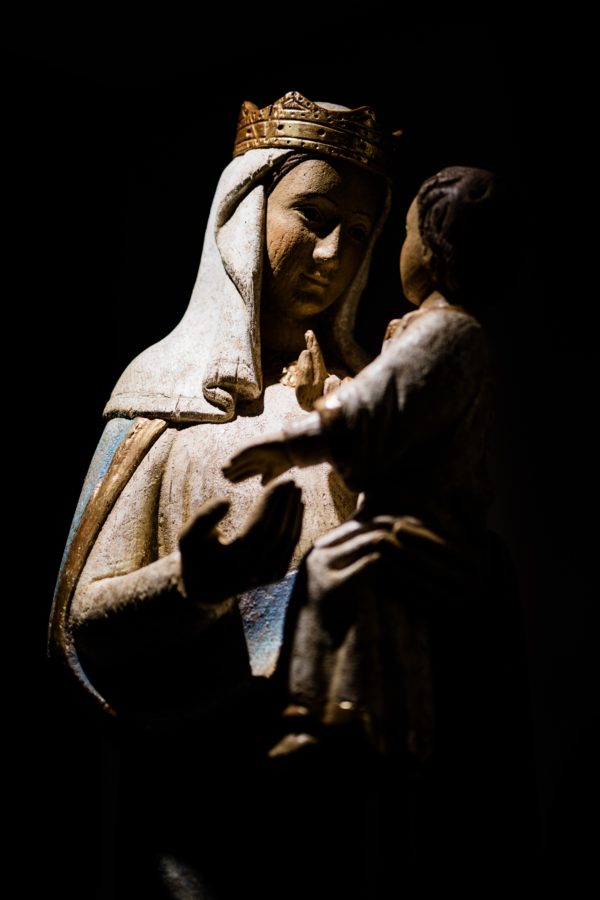
(image source: guardian.co.uk)

EmailFacebookGoogle ReaderPinterestTumblrTwitterShare

How My Kids Didn’t Ruin Mass

Confession: my kids are not typically little angels at Mass. ‘Typical” Mass behavior being our 3-year-old banging the kneeler open and closed and then dropping it on his own foot. Commence siren-like wailing. Or the kids tussling over who gets to hold the Baby Jesus finger puppet. And, to no one’s surprise, the preschooler throwing the St. Joseph finger puppet at his baby sister’s head doesn’t solve the dilemma. The newborn is startled out of a deep slumber by the bells heralding the Consecration and starts screaming. The toddler yelling (and I mean yelling) “Jesus! Jesus COME OUT!” as the Consecration approaches and he knows that “Jesus is coming.” And, yes, I said “typical” behavior. Don’t even get me started on the extraordinarily humiliating days.

Have you been there? When you just want to crawl into the floor and die of shame because surely your kids are ruining Mass for everyone? Your cheeks are burning? You consider a cross-country move?

You see, I grew up Protestant in a tradition in which young children do not attend “the service” until they can sit quietly with their families. It’s quiet, it’s composed, and you can actually hear the words of the sermon. I am still getting used to “the hum” that graces the background of every Mass: squirming toddlers, whispering preschoolers, fussing babies. Children are not banished to the nursery. Our Parish doesn’t even have a cry room. You see, children are not just tolerated, they are welcome. And what my parish has shown me, is that my children are wanted.

So that moment when I thought I would surely die because my 3-year-old made a mad dash for the altar when I was about to receive the Blessed Sacrament and I had to make an awkward wrangling motion to grab hold of his Houdini body in between the “Amen” and the moment the Host touched my tongue…well, the priest’s eyes didn’t narrow. He didn’t give me a stern look that said, “I hope the grace of Our Lord helps you recover from being the worst mother ever.” Nope. His eyes sparkled. He smiled. And, dear me, was that a quiet chuckle?

It’s the moments when I think my kids are the ultimate distraction that my parish family shows me that they are gifts of God’s grace. When the baby is fussy and the toddler is grumpy and loud and I think that surely the homily is going to be a desperate plea for our family to high tail it out of the church so everyone else can enjoy Mass in peace, the priest says, “Look around you. Look at all the babies and children in Mass today. As I’ve been hearing the sounds of infants and children this morning, it reminds me of the amazing gift of new life. What a blessing. I am so glad they are all here.” Gift? Blessing? My kids could have passed themselves off as small dragons this morning, and you heard their whispers and shrieks as echoes of God’s grace?

Or when the baby is insistent on nursing, even though I nursed her right before Mass and the only way to avoid a screaming fit is to nurse right there in the pew. I can feel my cheeks get warm and pink. Is my scarf covering us up? Am I flashing anyone? Is this ok? Is everyone looking at us? That lady in the back certainly is. Is she glaring at us? After Mass, there she is again. She’s probably coming to tell me off… But to my surprise she touched my shoulder and said, “I just wanted to tell you what a good job you did nursing that baby. You are such a good mom. It was so special to see a mother nursing in Mass. I remember having small kids in Mass and how hard it is. Your kids are always excellent.” Well…that last part was surely a kind-hearted fib, but could our family have blessed her by being there? By not sending our kids to the nursery? By trying to make it through Mass without causing a fire or anyone needing stitches? By choosing to nurse my baby, did that image of love between a mother and child actually make Mass more meaningful to her?

Because I think that’s part of what it means to be pro-life. To see children always as gifts of grace, not inconveniences. As always welcome as part of God’s family, not as distractions to be avoided. To encourage and love them and show them that they are wanted. That we want them there because Jesus wants them there. 

There’s one sweet couple and their adult daughter who have adopted our family during Mass. They make it a point to always sit near us. The mother is a bonafide baby whisperer and when Lucy gets fussy she will say in my ear, “You pass me that baby!” and she will snuggle a shockingly calm Baby Lucy sometimes for the entirety of Mass. Benjamin adores their daughter and on one occasion, we weren’t sitting close enough to “Miss Kerri” for his satisfaction. So he snuck out of our pew, tip-toed across the aisle, and plopped down right on her lap. As I prepared to stand up, bring him back, and reprimand him for leaving his spot, this dear soul gave me a look that said, “Don’t you dare! He’s FINE.” He sat like an angel with them for the rest of Mass. He even knelt quietly during the whole Consecration (usually our wrestling-match time). And as I knelt and peeked at him out of the corner of my eye, I started to feel tears roll down my cheeks. Because he looked so wanted, beloved, and cherished. Because this family’s love for my children communicates a vital message: Jesus loves them. Jesus wants them. They are not inconveniences and distractions. They are blessed outpourings of God’s grace.

I pray that during Mass, and every day, I can remember to see my children the way Jesus sees them. The way my parish sees them. I am so thankful for the love my children receive, even at their worst. And thankful for the reminder that Jesus wants all of us, even at our worst, to come and love and be loved.

EmailFacebookGoogle ReaderPinterestTumblrTwitterShare

Holy Time: The Joy of the Incarnation and the Pietà

The Incarnation of Christ, celebrated in the liturgical season of Christmastide, takes on a richer significance for me with each passing year. The story of the Nativity is fuller, but undeniably more strange. It loses the saccharine quality of greeting cards and becomes complicated. Christmas becomes more intricately connected to Holy Week and I’m reminded that the miracle of the Incarnation isn’t merely that Our Lord was born as a human on the very earth I walk on, but that He came in order that he might die. The wooden manger foreshadows the wooden cross where his life will be extinguished. The joyful songs of angels at Our Lord’s birth precede the agony of the heavenly hosts at his death. The wise men bring myrrh, perfumed ointments for funeral preparations, to point to Our Lord’s true purpose in visiting this planet. The ecstasy the Blessed Virgin must have experienced when she first beheld him brings to mind her unrivaled suffering as she watched his torturous Passion. It is all one. It is all connected—God’s unfathomable love and sacrifice for humanity.


In some artistic renderings of the Nativity scene (I have Giuseppe Vermiglio’s Nativity and Adoration of the Shepherds in mind), there is a strange image included in the stable. It is a lamb, but not a cuddly creature adoring the precious Baby Jesus. It is a lamb with its legs bound, the sacrificial lamb that will be taken to slaughter, reminding us, as St. John the Baptist does, that when we see the Christ Child we are beholding the Lamb of God who will carry our sins to the cross.

I had a strange experience at the Christmas Mass this year. We sang this beautiful hymn:

What child is this, who, laid to rest,

On Mary’s lap is sleeping?

Whom angels greet with anthems sweet,

While shepherds watch are keeping?

This, this is Christ the King,

Whom shepherds guard and angels sing:

Haste, haste to bring him laud,

The babe, the son of Mary.

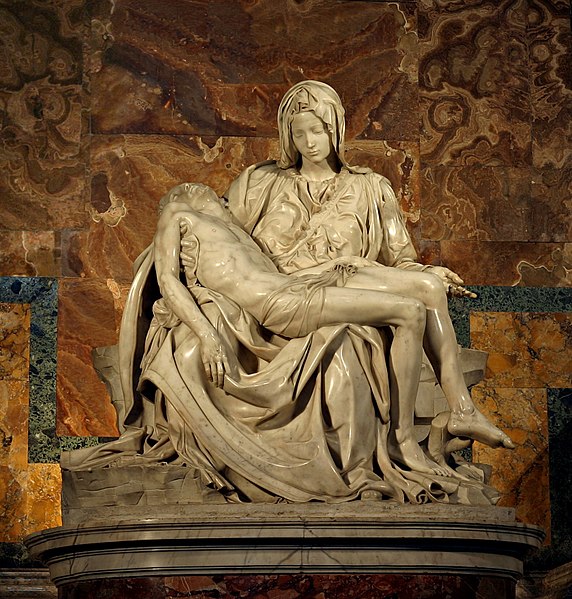
In the past this song has always conjured an idyllic image of the Infant Christ contentedly snoozing in his mother’s arm. But when I heard the words this year, I did not think of Bethlehem, I saw Golgotha. I saw a grieving Mother Mary cradling the dead body of Our Lord. I saw the Pietà, Michelangelo’s masterpiece that cries out in its sorrow and beautyBehold, God’s love for you.

The Nativity isn’t cute. It isn’t clean. The God of the Universe is born among animal dung right in the thick of humanity’s filth. He comes to give up everything, including his very life. But it is an undeniably beautiful scene because it is an image of God’s unwavering love.  His coming is the moment all creation has waited for with tears and groaning, like a woman in labor. Everything hinges upon it.

The school shooting at Sandy Hook Elementary is by no means the only tragedy that occurred during this holiday season. But it has made us grapple with the meaning of Christmas. I love what Ross Douthat said in his piece, “The Loss of the Innocents”:

…the Christmas story isn’t just the manger and the shepherds and the baby Jesus, meek and mild. The rage of Herod is there as well, and the slaughtered innocents of Bethlehem, and the myrrh that prepares bodies for the grave. The cross looms behind the stable — the shadow of violence, agony and death. In the leafless hills of western Connecticut, this is the only Christmas spirit that could possibly matter now.” 

Perhaps if we did not suffer, we could just see the Nativity as merely heart-warming and leave it at that. But, in this our exile, we grasp at the truth of the Incarnation as we cling to the Cross where our Savior’s arms are outstretched crying out, “Behold, God’s love for you.” And this most grotesque and most beautiful of all images, the Crucifixion, is what makes the Incarnation our source of hope. The true King has come to offer himself as a sacrifice for us. To heal what is broken. To set all things right. His sacrifice, his death becomes his triumph and our salvation. Take heart, I have overcome the world. And knowing that, we can sing “Joy to the World” with full hearts.

image source: saintpetersbasilica.org

EmailFacebookGoogle ReaderPinterestTumblrTwitterShare

Little HolyDays: First Advent

Something from the archives today. I wrote this little reflection soon after Benjamin was born. It feels appropriate especially since I’m expecting during Advent again. Don’t forget to link up with Little HolyDays with your old and new posts for this second week of Advent (Link Up at the bottom of the page)!

I was huge. Not just big—gigantic. Even before I entered my third trimester, well-intentioned old ladies would pat my shoulder and say, “Any day now!” encouragingly as I waddled my way through the grocery store. Considering the raging pregnancy hormones running through my system, I’m impressed that I didn’t slap any of the kind-hearted dears. I was huge.

As it neared the end of November, I started wearing flip-flops exclusively because my swollen feet wouldn’t fit into anything else. I think I gave up on other footwear after one particularly bad day when my husband had to help me get my boots off as I helplessly yelled inchoate phrases about being the only woman who would be pregnant forever. My maternity coat didn’t fit anymore by the time it was cold enough to wear it which enraged me further. When I wasn’t at work, I was lying on the couch or in the bath tub trying to remember what it felt like to be able to see my toes.  Then I would see a tiny limb change position—reminding me that my massive tummy housed a moving, living child.

As December neared and Advent began I considered this season for perhaps the first time. I had lighted Advent candles as a little girl and been excited about Christmas coming but had never considered the season as anything except a Pre-Christmas countdown. I came to realize that this is as incomplete an understanding of Advent as a definition of pregnancy as simply the nine months preceding a birth.

While I tried to remember what my feet looked like, I remembered the Blessed Virgin Mary.  I confess that I had never thought much about her before. I had never felt that we had anything in common until now. But as my belly got rounder and rounder and my back got achier and achier, I remembered her. She has done this, I thought. She has felt her child move in her womb, perhaps even responding to the sound of her voice or her song. She experienced this miracle of life taking place within her.

In our modern disenchanted age we have not completely lost our fascination with the miracle of new life.  Whenever I dragged my sleepy pregnant body to public places my experience was different than ever before. Little children looked at my belly, fascinated, sometimes even trying to give my belly a pat or lift up my shirt to discover if there was really a baby inside. Other mothers smiled at me and grandmothers reassured me. My ordinary child, this new ordinary life, elicited such a response of amazement. How much more miraculous is the coming of our Lord?, I began to wonder.

For unto us a child is born.  Unto us a son is given.

I was expecting my son during the season of expectation. The word comes from expectare—to wait, to hope, to look for. I did all this things. At first there was a contentment in the waiting and the hoping but eventually the groaning, miserable discomfort led to a readiness to be delivered of the tiny tyrant reigning over me from my womb.  A week before my due date I was so exhausted and so tired of bumping the counters with my colossal tummy and getting up 10 times a night because the little angel had given my bladder yet another energetic punch, that I began to lose it a bit. I couldn’t go to work one more day.  I couldn’t fit behind my desk. I couldn’t sleep. Until the discomfort crossed a certain threshold and I was struck with a desperate desire to be pregnant not a day longer, the pain of delivery was alarming to me and I remained unprepared.  Now it did not frighten me. Anything but this. I started to understand that it is not until we are exhausted, ill with our condition, miserable, that we are ready for Christ—when we can really desire to be delivered.

I kept thinking about the Blessed Virgin Mary. Was she as desperate to give birth as I was? I considered with wonder how when her baby boy was delivered, he would in turn deliver her, deliver me, deliver my own unborn son.

As I waited in joyous, miserable, anxious expectation, I started to understand an inkling of what it must have felt like to wait for the Messiah, Mary’s son. I begin to understand the Joy born to the world on Christmas and present with us now as I heard the sound of the first beautiful and strong cry of my newborn son. I realized in a new way how to wait with groaning and expectation for our Lord’s return in glory. It was my first Advent.

—————————————————————————————————

Now it’s time for you to share your posts! (And be sure to check out some of our favorite links from last week at MollyMakesDo this morning.)

We are three Catholic bloggers (Carrots, MollyMakesDo, and Dualing Moms) who love to observe the liturgical year to deepen our families’ faith and build up the domestic church. We would love to hear about your family’s celebrations and traditions! Please join us in “redeeming the time” in this Year of Faith by sharing your posts (old or new) about feast days, liturgical seasons, etc. in this new linkup. We are starting at the beginning of the Liturgical Year: The Season of Advent!

Some topics we would be excited to read about during the Advent and Christmas seasons are (but not limited to!):

  • Sustainability and Responsible Gift Giving/Food
  • Food & Recipes
  • Simple Holiday traditions, crafts and activities
  • Reflections on the seasons
  • Charity
  • Teaching and Learning  about the Christian Year with Children

This link up will be open until Thursday evening, December 13th. There will be a new link up open on Monday, December 17th, and we will highlight some of our favorite links from the previous week in the new post, and on a Little HolyDays Pinterest board.

For the three of us, this link up is a way in which we plan on exploring and deepening our Catholic faith, but we would really love to hear from bloggers of all denominations.

We welcome you to share your own feast, festivals, and celebrations that fall within each week of December.

As moderators of this link up, we will reserve the right to remove any offensive or off-topic posts as we see fit, in order to maintain a kind and positive atmosphere.

So, here’s what you do:

1. Click the linky below to add your post to the Little HolyDays link up.

2. Add the Little HolyDays button (code below) to the bottom of your post so your readers can find the other great links!(If the code doesn’t work for your blog, just link to one of the hosts and don’t worry about the button.)

3. Come back next week to see our favorite posts from the previous week and link up again.

We can’t wait to read your posts and get inspired by your traditions!


My Button

<a href=”http://carrotsformichaelmas.com” title=”Carrots for Michaelmas”> <img src=”http://i1145.photobucket.com/albums/o515/Mollymakesdo/DSC_0740-1.jpg” width=”200″ height=”200″ alt=”My Button” style=”border:none;” /></a>


Powered by Linky Tools

Click here to enter your link and view this Linky Tools list…


(You have to click through to see the links. Thanks for joining us!)

EmailFacebookGoogle ReaderPinterestTumblrTwitterShare

Sleepers, Wake! An Advent Music Guide and Playlist

Are you enjoying the Little HolyDays link up? I have loved reading the posts you’ve shared! Here’s a little more Advent fun and don’t forget to link up with your posts (old or new) about Advent, St. Nicholas Day, the Immaculate Conception, or family seasonal traditions until the link up closes Thursday!

After explaining how we fast from Christmas music during Advent (and then turn up the jams during the Twelve Days of Christmas until Epiphany!), I get a variety of reactions including “Are you insane?” Well, probably. And “so, what DO you listen to during Advent?”  To be honest I am just now discovering “Advent music” instead of just abstaining from Christmas music and I have completely fallen in love with the haunting and hopeful liturgical music of the season. I can’t wait to share it with you and I’ve even created an Advent playlist for your listening pleasure (at the bottom of the post)!

So, here’s my guide to Advent music so that you don’t have to play “O Come, O Come, Emmanuel” on repeat for several weeks until you’re ready to blast “Joy to the World!” on Christmas morning.

First of all, you might discover, like I did, that some of your favorite “Christmas” tunes aren’t actually Christmas tunes at all! “O Come, O Come, Emmanuel” and “Lo, How a Rose E’re Blooming” have always been my favorites and behold! They’re Advent songs, so you can jam out to them right here, right now!

Now, it’s time to discover some Advent hymns you might not be familiar with. Maybe I’m the last person on earth to hear “O Come, Divine Messiah” but it’s so beautiful and I am hooked! We’ve started singing it each night as we light our Advent candles. A great introduction to some traditional Advent songs is the Advent at Ephesus album. A reader first suggested it and then sweet Melanie of Trendy Traditions gifted me with the album and I haven’t stopped listening to it! In the car, at the house, all the time.

Another Advent favorite in our household is Handel’s Messiah. It’s not all Adventy, there’s some Christmasy parts and even Lenten and Easter sections but I love how it depicts the big picture of God’s redemption which is an important idea to reflect on during Advent.

One of my most beloved Advent tradition is going to the community “Messiah Sing” with my mom every year. A couple hundred folks show up and create the chorus and amazing soloists take on the difficult solos. My mom and I have our own scores and we rock the Alto section. I took Lucy last year in the Maya wrap because she was still nursing every hour or so and I think I nursed her all the way through the Hallelujah Chorus.  I even flew home from Texas to attend with my mom when she was going through chemo for breast cancer. It was the best way I could think of to show my encouragement and support. Even though she felt crummy from her treatment, going together that year is one of my favorite memories and I’m more grateful each year to have the honor of sharing this tradition with her and the grace of her presence in my life.  So the Messiah is a big part of Advent for me.

I also saw some great Advent music inspiration from Christy from Fountains of Home and Abbey of Survivng Our Blessings. Great Advent suggestions and Abbey even included an Advent Playlist.

I’m enjoying following @OccupyAdvent on Twitter and reading their Advent playlist suggestions because they’re suggesting popular songs about waiting and Adventy themes like Johnny Cash’s: “When the Man Comes Around.” Such a great song. Or Mumford and Sons “I Will Wait.” I included them both on my playlist. What songs do you love that could fit into an Advent theme even though they’re not technically about Advent?

Here’s my playlist of all my favorite Advent songs (and some songs that kinda sorta fit the theme even if they’re not technically religious.) Enjoy! (You’ll need Spotify to listen, but it’s free and awesome so you’ll thank me later.)

A few remarks on the Sleepers, Wake! Advent playlist:

“O Come, O Come Emmanuel” – Sufjan Stevens (This is my all-time favorite version of this song. I love Sufjan always and forever even though the Age of Adz tour made me want to cry and go back to listening to Seven Swans.)

“Come Thou Long-Expected Jesus” – St. Olaf Choral Ensembles (One of my favorite hymns. I didn’t realize til recently it was an Advent song.)

“I Will Wait” – Mumford and Sons – (Waiting, Hope, Expectation….it’s a stretch but it works, right?)

“Lo, How a Rose E’er Blooming” – Charlotte Church  (Again, one of my favorite hymns. I love Sufjan’s version, too.)

“O Come, Divine Messiah” – Benedictines of Mary, Queen of Apostles (Currently my favorite Advent song. We are singing it when we light our Advent candles each night.)

“Til Kingdom Come” - Coldplay (OK, it’s a reach but “For you, I’d wait ’til kingdom come.Until my day, my day is done. And say you’ll come, and set me free…” It works, right?)

“Gabriel’s Message” – King’s College Choir (Classic Advent hymn.)

“Creator Alme Siderum” – Gregorian (Gorgeous.)

“The Man Comes Around” – Johnny Cash (Perfect for Advent. Perfect for anytime. I love you, Johnny Cash. If this doesn’t get you fired up for Advent, I don’t know how to help you.)

“Rorate Caeli” – Chant Meditation (Didn’t know this one until trying to find Advent songs. So lovely.)

“Alma Redemptoris Mater” – Sequentia (Same story. I want a class on beautiful Church music.)

“People Look East” – The Girls Choir of Bath Abbey (One of the beautiful Advent songs that we actually sing at my parish. Wish there were more but I’m grateful this one is so good.)

“Comfort Ye” from the Messiah – Handel (This gives me chills.)

“Lo, He Comes with Clouds Descending” – Choir of St Edmundsbury Cathedral (Another classic.)

“Sleepers, Wake” – Bach (Didn’t realize this was Adventy, but I’ve always loved it so I’m excited for another excuse to listen.)

“Rejoice, Rejoice, Believers” – St. Olaf Choir Ensembles (Who’s ready for Christmas!)

What are your favorite Advent tunes?

EmailFacebookGoogle ReaderPinterestTumblrTwitterShare

Little HolyDays: The Feast of St. Nicholas

Welcome to our first Little HolyDays link up and Happy New Year! No, I haven’t gotten the months confused, it’s the beginning of a new liturgical year. Yesterday was the first Sunday of Advent. Let’s hope you were more organized than I and didn’t spend part of your Sunday scrambling around looking  for your Advent wreath (don’t worry! I found it!).

Anyhow, for our very first Little HolyDays link up (yay!) I wanted to share with you about what we’ll be doing to celebrate the Feast of St. Nicholas on Dec. 6th. (The Little HolyDays link up is at the bottom).

Until recently, I didn’t know anything about St. Nicholas other than the fact that Santa Claus is his strange holiday descendant of sorts. When I did get to know St. Nicholas a little bit, he turned out to be a huge surprise. This ain’t yo’ grandma’s saint! Well, I don’t know your grandma. Maybe she has a great devotion to St. Nicholas. But what I’m trying to say is, St. Nicholas is nothing like his jolly, rosy-cheeked, red-suited, cookie-snarfing counterpart who is concerned with everyone’s “niceness.” In fact, I don’t think St. Nicholas put much stock in “being nice” but he was a fighter for the truth—literally.  From examinations of this holy bishop’s relics in Bari, Italy, it’s clear that he sported a seriously broken nose. It appears to be broken multiple times and some legends even claim he grew up as a street fighter. We do know that he was kicked out of the Council of Nicea for punching the heretic Arias in the face. Arias was teaching that Christ was not fully divine and St. Nicholas just couldn’t listen to another word.

Image from cantaur.blogspot.com

Fist raised and causing a riot. Jolly Old St. Nicholas, right?!

While I’m not advocating punching heretics in the face, (and he did get in big trouble for his violent act), I can’t help but love St. Nicholas for his fiery passion for the truth. In case the face-punch tale has you convinced that St. Nicholas was a big jerk, let me tell you a couple more stories to reveal this saints courage and compassion. Upon hearing that three innocent men were going to be executed, St. Nicholas ran to the scene and demanded that the executioner put down his sword. The courage and authority of the saint halted the execution and the prisoners were freed. Or maybe the executioner heard about what happened to Arias. When St. Nicholas heard that a poor man’s three daughters had no dowry to marry and would likely be forced into prostitution, he anonymously provided them each with a generous dowry. This may be how the tradition of giving gifts to children on St. Nicholas Day got started. I love St. Nicholas’s passion and active love, even though it must have gotten him into trouble sometimes. I think his devotion to justice, truth, and charity is something that merits a big celebration.

At our house, we exchange gifts on St. Nicholas Day instead of Christmas Day. It’s traditional to fill children’s shoes with little presents and so we buy each child a new pair of shoes, fill them with little edible treats, and wrap up any other little gifties we’re giving our little ones. Presents at our house are a simple affair, but we don’t want them to be the focus of Christmas so we like enjoying them together on a different day. We do join my husband’s family on Christmas Day to exchange gifts with them, but so far I think our kids enjoy being together with their extended family as much as the gifts. The presents themselves don’t seem to take the spotlight off the meaning of the day. How do you arrange gift-giving in your Christmas traditions?

This year, as St. Nicholas Day falls on a Thursday, we’ll try to attend the 7am Mass followed by presents and we’ll end the day with a feast: Sparkling Pear Juice as a special treat for the kids (and this pregnant gal), Cranberry Chicken from this cookbook, fresh greens from our urban garden, and I’ll try to create a gluten-free version of these traditional St. Nicholas Day spice cookies.  In general, our Advent is pretty somber: lots of vegetarian meals, simple soups, and quiet evenings. St. Nicholas Day is a bright spot in the First Week of Advent.

We don’t really celebrate Santa Claus, although our kids know who he is and know that many families do Santa-related things during the month of December. And I don’t think Santa is bad or that family’s with special Santa traditions should give them up. But let’s be real, in a contest for awesomeness, I think the generous, brave, face-punching saint is the clear winner. :)

***********************************************************************

Now it’s time for you to share your traditions!

We are three Catholic bloggers who love to observe the liturgical year to deepen our families’ faith and build up the domestic church. We would love to hear about your family’s celebrations and traditions! Please join us in “redeeming the time” in this Year of Faith by sharing your posts (old or new) about feast days, liturgical seasons, etc. in this new linkup. We are starting at the beginning of the Liturgical Year: The Season of Advent!

Some topics we would be excited to read about during the Advent and Christmas seasons are (but not limited to!):

  • Sustainability and Responsible Gift Giving/Food
  • Food & Recipes
  • Simple Holiday traditions, crafts and activities
  • Reflections on the seasons
  • Charity
  • Teaching and Learning  about the Christian Year with Children

This link up will be open until Thursday evening, December 6th. There will be a new link up open on Monday, December 10th, and we will highlight some of our favorite links from the previous week in the new post, and on a Little HolyDays Pinterest board.

For the three of us, this link up is a way in which we plan on exploring and deepening our Catholic faith, but we would really love to hear from bloggers of all denominations.

We welcome you to share your own feast, festivals, and celebrations that fall within each week of December.

As moderators of this link up, we will reserve the right to remove any offensive or off-topic posts as we see fit, in order to maintain a kind and positive atmosphere.

So, here’s what you do:

1. Click the linky below to add your post to the Little HolyDays link up.

2. Add the Little HolyDays button (code below) to the bottom of your post so your readers can find the other great links!

3. Come back next week to see our favorite posts from the previous week and link up again.

We can’t wait to read your posts and get inspired by your traditions!


My Button

<a href=”http://carrotsformichaelmas.com/2012/12/03/little-holydays-the-feast-of-st-nicholas/” title=”Carrots for Michaelmas”> <img src=”http://i1145.photobucket.com/albums/o515/Mollymakesdo/DSC_0740-1.jpg” width=”200″ height=”200″ alt=”My Button” style=”border:none;” /></a>


Powered by Linky Tools

Click here to enter your link and view this Linky Tools list…

(You won’t see the links until you click through. Thanks for joining us!)


EmailFacebookGoogle ReaderPinterestTumblrTwitterShare